



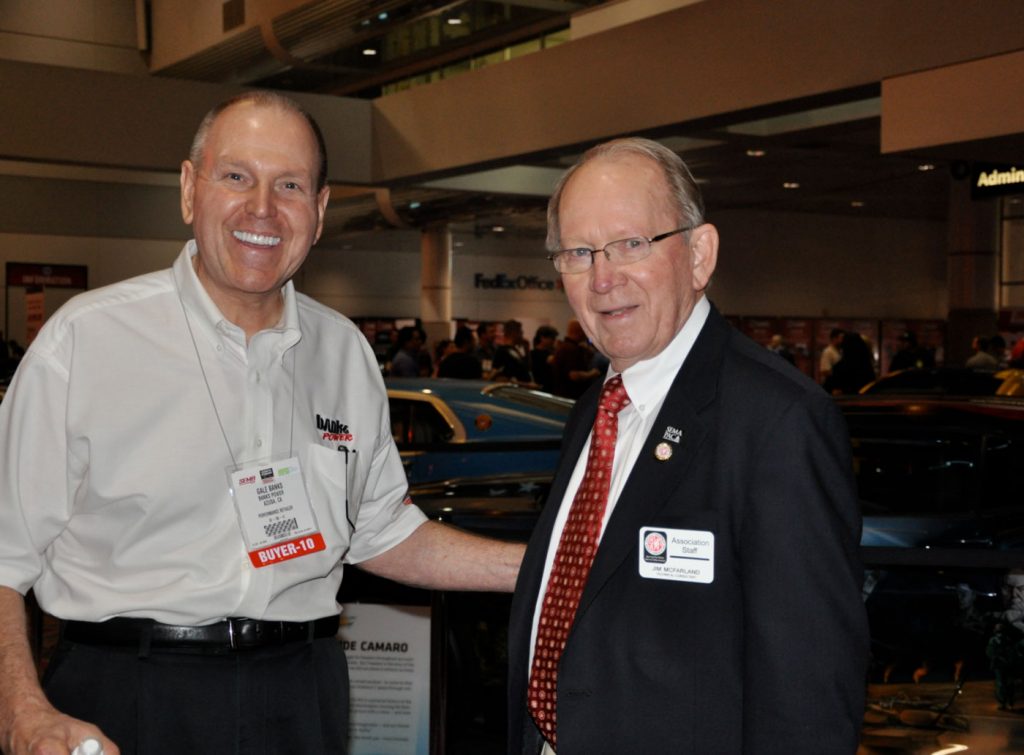
Straight Talk With the Man Largely Identified as the Creator of the Diesel Aftermarket
Gale Banks is a hot rodder from the word go and is just as involved today as he was 50 years ago when he founded the company. But long before that, he was a gearhead, and until this day he remains a gearhead through and through. With an engineering background and a deep passion for racing, setting records, and helping others to race and accomplish their personal record attempts, this is a man who has not only followed his dream but along the way, he has established incredible performance standards as well as created a host of innovative power-producing components and systems long before it became fashionable to do so. Largely renowned as the man who invented performance diesel, Gale Banks may not have built the first diesel to go fast and break records, but he largely forged the entire diesel aftermarket when others couldn’t be bothered. Gale Banks created and offered Banks diesel power products when the aftermarket industry was still building small-block Chevy parts for the most part (since the early ‘80s), and even when the hot setup was to force-feed engines using roots-based blower technology, Gale Banks went one better—he built stout-running twin-turbo gas and diesel engines that hauled the freight, literally. His turbo systems have powered many a Suburban and fast ski boat, and he went on to embrace the motor home market by providing engine and exhaust systems that helped those largely underpowered rigs to achieve better over-the-road fuel mileage, pull heavier loads, and run cooler when faced with the rigors of the hot mountainous terrain that seem to delight so many retired motor homers who thank Banks for helping them to enjoy their lives on the road
“While most of you are more than familiar with the company Banks Power and the many industry-leading, power-producing products it manufactures — the Six-Gun power programmer, Banks PowerPack, Banks PowerPDA, Ram-Air intake systems, Techni-Cooler intercoolers and the extremely popular Big Hoss performance bundles — what you might not know is that there is a very passionate man behind the company that bears his name.”
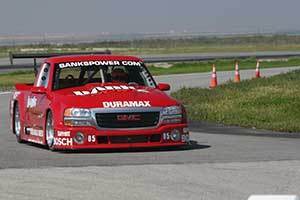
Always an innovator, Gale Banks is a perfectionist and always has been. All of his personal projects have been super-sanitary, purpose-built machines focused on the goal ahead. As he has accomplished setting all manner of records and automotive accomplishments over the course of his career, Gale Banks doesn’t sit until he continues to investigate that next speed and performance barrier—like building a road race diesel-powered pickup. Now you must appreciate this, as Gale had this diesel road race idea long ago, and he spoke about it regularly, as he continued to develop the technology in his head, figuring out how he would apply this and that, and what was needed before the project could be completed and perform to his standards. He didn’t only talk about it; he began building his GMC turbo diesel pickup to test his ideas. This all occurred prior to Audi putting its new V-10 turbodiesel in the multiple LeMans-winning R10.
What drives Banks is his tremendous appetite for the unknown, his automotive curiosity, and his tremendous ambition to make things go fast—especially diesel. He enjoys trying the unusual, and what’s more, he’s been tremendously successful at it. Of course, trying to sit him down to talk about these things, his insight, projections, and personal aspirations is no easy task. It’s not only because of his busy schedule but because he’s the type of man who would rather do than to talk about it. We did manage to have Banks agree to sit down during the busy SEMA show so that we might discuss the state of the performance diesel industry, diesel racing as well as some of the cool things his company is doing to help ensure that we have a performance diesel industry in the future.
With Banks’ vast experience and extensive background in racing and performance of all kinds, one might expect him to be aloof, unreachable, thinking beyond the conversation, or perhaps that he would talk over your head because of his engineering background. However, that’s not at all the case. Gale Banks is a very approachable guy who has a deep well of automotive knowledge that he is willing to share with those who appreciate such insightfulness, and we were quite appreciative of the time he affords us for this one-on-one conversation.
Gale Banks has a lot to say on several topics, all of which are very important to the aftermarket diesel industry, not to mention diesel gearheads of all kinds, who will find his observations stimulating. However, we’ll leave that up to you, as Gale Banks discusses diesel power and the state of affairs for the diesel aftermarket, and this from the man who started it all. Enjoy!
DB: With fuel prices climbing the way they are, a great deal of attention has been placed on diesel-powered vehicles—by consumers and by the EPA. Do you think the additional EPA attention will have an effect on the diesel performance market?
GB: If we’re talking about consumers who hot rod or enhance the power output or trying to enhance the efficiency of their diesel, yes. I think the EPA’s attention will have an effect on the market. Currently, diesel racing of any type, a diesel-performance event, or an off-road type sanctioned event, virtually every participant will have an incredible smoke output from their engine. They’re just over the top. It’s a very inefficient thing to do, run your engine like that. But guys who are into diesel performance think that’s cool. And they really dig on the smoke.
Frankly, I look at it and I go, “Hey, this is a performance that you can see and not feel. Smoke is horsepower in the air and not used.” So, to me as a racer, and part of racing is pit stops and fuel efficiency, so you don’t have to make too many of them, except for drag racing. The bottom line here is smoke, in my estimation, is low performance. The guys that have put all that kind of stuff in the air would do far better to get more air into the engine and burn that fuel, thus making more power.
We’re now demonstrating that statement to be absolutely true. First, we demonstrated it in 2002 when we ran the world speed record for pickup trucks with our Dodge Dakota Sidewinder, which was powered by a Cummins 5.9-liter engine. No smoke whatsoever and it went on to be the World’s Fastest Pickup Truck. We still hold that record today. It’s now 5 years old, and if you add the word “diesel,” we still hold that record. There is a faster gas-burning truck now, but we’re going to go after them with the diesel, too. So, the bottom line here is burning the fuel in the engine is the preferred way to do it. If you do that, you don’t have the smoke signature.
The problem we’ve got is a lot of the guys sell dirty tunes. Their tuners or programmers or their big injectors, or whatever, double fuel-injection, high-pressure pumps, all of these things supply fuel that is going right out the exhaust pipe. It’s nuts.
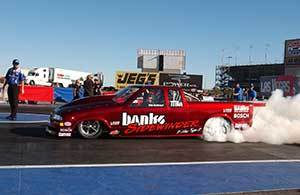
We’re currently running a drag race truck, which also happens to be the world’s quickest and fastest diesel drag race truck…and there’s no smoke coming from that one either, and we’re only running one injection pump. How is it that we can run one 3.3 Bosch pump and beat these guys that are running all kinds of additional fuel capacity on their engines? All of them blow smoke, but we make clean passes, and we’re quicker and faster. If that doesn’t prove what I’m saying to the smoke boys, then God help them.
What we intend to do at Banks is go out and run a number of different vehicles to demonstrate how to do this, and hopefully the guys out there will get on board. We’re going to go to these meets and run with the smoke boys, and we’ll have a good time. The problem is that a lot of the guys that are into smoking out the car next to them on the street and those people are the ones calling the EPA. SEMA had a meeting with CARB and the EPA on Wednesday of this show, with four other manufacturers and us. The whole thing was about the smoke that typical performance products produce on the street, not on the track. You see, there is a difference.
The same thing that runs on the track isn’t acceptable in its current form on the street. They were looking at the smoke and emissions defeat devices, or gizmos that make the truck run with the emissions devices removed. EPA and CARB are out to get these diesel smokers. As a member of the SEMA Board of Directors and the only member in attendance, I was in effect carrying the water for the rest of the diesel performance industry. It’s SEMA’s job, and mine too, now to protect the industry, not squash it.
The message is that if we don’t get the smoke to stop, then it’ll be impossible to stop the EPA and CARB from forcing tighter restrictions on the industry as a whole or even bring the whole thing to a halt. The folks who don’t get on board are going to stab themselves and the rest of us in the back. The smoke boys have got to get with the program before they ruin things for the lot of us. It’s truly time for the diesel performance industry to clean up its act.
DB: So even with Diesel Particulate Filters (DPFs) on the new-generation diesel engines, consumers can still make more power and improve the performance of their engine?
GB: Absolutely, but there has to be quite a caution here. This is where the preferred embodiment, the way guys have been doing their tuners, with the exception of Banks, has been that smoke is a benefit. We’ve taken the clean tune approach since we started in diesel, way back in 1982 with our turbo kit for the 6.2 Sidewinder GM Diesel. The whole idea is for the minimum to no smoke, especially with a diesel particulate filter.
These things filter out what remains to make these engines legal under current emissions law. There is still a little bit of particulate matter coming out of these engines, so the bottom line is if you’re going to tune and keep the DPF (which is the legal thing to do on the street) then you cannot be putting excess smoke out, because it will kill the DPF. I don’t know how the guys out there are going to do this. This is going to separate the men from the boys, but the bottom line is that you’ve got to have an immaculately clean tune. You may not make as much additional power as you did previously, but you’re going to have to settle for it. That’s the bottom line.
How will the guys who are not enginemen handle this? We have a distinct advantage because, at Banks, we are enginemen. Most of these guys just make tuners and that’s their life. With us, we design engines and build vehicles from scratch. So, we deeply get the combustion process inside the engine. We understand it, and that’s why we’ve been able to run diesels that don’t smoke but win records. Now, these guys will not be able to put out the smoke and smoke out the old lady going to church who’s riding in a car next to them. That part of their manhood is going to have to cease. I’m talking about the customer.
The DPF will regenerate…it does clean itself, but it only cleans itself so many times before it’s dead. If it’s made to clean itself twice as often, it’s going to die before it even reaches its required 120,000-mile durability. Somebody is going to be paying for that, and I hope it isn’t me. By that I mean, I hope our industry (the diesel performance industry) is not killed a year or two from now when those filters start failing prematurely. So, it’s going to be a buyer-beware marketplace.
If the tuner guys out there don’t know how to measure diesel particulates, and this is not done with a smoke meter or an opacity meter, then they are done. At Banks, what we are generating is a device that I’m calling a “smoke tunnel,” and that will give us the ability to measure extremely low levels of particulate matter or smoke.
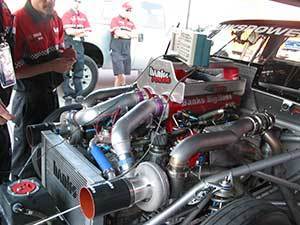
DB: We have heard that in addition to the Duramax powered Chevy S-10 drag truck you have plans for other diesel-powered drag racing vehicles, can you elaborate?
GB: There are a lot of guys who are running extremely heavy trucks and are really proud of what they do, and there’s nothing wrong with that…but if I’m going to spend the kind of money that they’re spending, I’m not going to run a slow truck. I’m going to build a vehicle that is the quickest and fastest truck. That’s kind of how I’ve always done my career. As far as what else we might build other than the S-10? Well, when you question what’s the fastest configuration in drag racing, the answer comes up as being a dragster. So, I’m going to do a diesel-powered dragster. I think there are some milestones to be set there with diesel power, and we’d like to be the first ones to do it. That’s kind of the history of the company, Banks Power.
DB: Well, building Banks race vehicles is cool, but what are you doing to help your customers that want to take their rigs to the track? Do you have any special Banks parts for them?
GB: Absolutely. We have what we’re going to call Bankspeed. Over the years, we’ve developed a lot of racing parts—intake manifold castings, pistons, camshafts, wrist pins, oiling systems, flywheels, torque converters, vibration dampeners, on and on and on. Really, it’s all the kind of stuff that you truly need to build a proper racing engine. We’re going to now offer all of those parts at affordable prices, just so that diesel racing, in general, can become more professional.
There’s an awful lot of old-school smoke mentality, run the thing until you split the block lengthwise, and then wonder if you did it with cylinder pressure or did you just hydraulic the thing with so much unburned fuel. The bottom line here is that we’re going to produce the parts to run a diesel clean and fast, and for a very long time…and we’re going to offer them to anybody who wants them. It’s going to be no holds barred here. We’re going to build demonstration vehicles to show that the stuff works and we’re going to set records doing that. We really would like to see the rest of the diesel guys take what we’re doing and use what we’ve developed and go out and kick our ass with it. There’s always inventive guys who can improve on what we or anyone has done. We just want to show that it can be done smoke-free. That’s our deal.
DB: Speaking of racing and records, what have you got up your sleeve for Bonneville, are you doing more with the Dakota or is there something else in the works?
GB: The Banks Sidewinder Dakota holds a current record of 217 mph and change—a two-way average that is done under international rules, which are far tougher than running a national record. Nevertheless, it doesn’t matter how you run it, whether it’s national or international, you want the fastest speed. The SPAL guys have their little red Ranger pickup with a Ford diesel in it. It’s taken them five years to finally get our national record, which was 213 mph, and they’ve run 215 mph. They’ve got some good one-way runs, but their engine is a hand grenade, and it just can’t come back because there’s not enough engine to go fast in both directions. Really, that’s what this is all about. Records are two-way; hand grenades are one-way. It’s a test of the engine builder’s skill to make the thing run further than one-way and blow the engine. You can talk about a one-way speed, but it ain’t a record. Anyhow, they’re close, and I want to race them. We’re doing a new Cummins program, and we’re going to come back to run that truck at Bonneville. I also want to run my streamliner. There’s a 350 mph or so record out there for World’s Fastest Diesel. Those fellows have a lot of car—it’s a twin-engine, all-wheel drive, and a very scientific streamliner. I’ve got a very hot-rod streamliner that’s been 382 mph with a 950hp engine in it, and I think there’s 400 mph in this thing with the proper diesel. We’ll have to decide which diesel engine that will be, but I want to bring the Banks Sidewinder streamliner to the salt in ’08. So we’ve got two vehicles going to the salt: a blown-gas ’53 Studebaker that I’m running with Bruce Geisler and Gary Vail…but that’s not a diesel and the streamliner. I’m planning on quite a campaign at the salt this year in August, September, and October. Some of the Banks speed parts that we’re making, like the SFI-approved flexplates to drive torque converters we’re going to be using. So, you might say that some of the safety equipment aspects we’re providing for too.
DB: In the recent issues of DIESEL BUILDER, we featured a Hummer H3 and an H2 that had been converted to diesel with Duramax engines under their hoods, we love seeing more guys come into the diesel fold and we’ve heard that Banks Power will be offering an ECM that will make swaps like this much easier. What can you tell us about the new ECM and when will it be available?
GB: Well, we’re coming out with a diesel ECM, which will either be pre-programmed for your application or pre-programmed with our Six-Gun tuner and PowerPDA front end that would allow you to configure the thing in a variety of ways—maximum engine speed, fuel rate, timing, you name it.
That ECM will enable folks to do what we’ve been doing for 6 years now: running a common-rail diesel powerplant in a race vehicle, custom vehicle, and enable swapping them into an older car or truck. A lot of those older, pre-emissions trucks and cars are ripe for this type of diesel hot rodding. The ECMs will be far cheaper than a hot-rodded mechanical injection pump setup and will run cleaner to boot. We’re also going to be offering complete Duramax crate engines, ready to go in whatever you might want to put it in with a wiring harness and the ECM.
DB: Now that’s the kind of innovation we expect from Banks Power, this ECM sounds like it will be great for anyone who wants to swap a diesel engine into a project vehicle. Are you guys building anything unusual with a diesel engine swap?
GB: My dream is to do an all-wheel-drive vehicle with a twin-turboed V-8 D-max in it. I’m thinking that it would be hot in a ’32 Ford Deuce roadster. That’s one. The second one is a diesel pickup that I can drive on the street, drive in the Power Tour, and also go and do the stationary dyno test. A lot of guys that do those stationary tests don’t do much else with their truck. It’s kind of a dyno potato. It doesn’t go anywhere. It gets towed to the dyno, it runs and it gets towed away. Some guys pull with them or even drag with them, too. I want to do a street setup where we can drive to do the dyno thrash, after that, put on the slicks and drag race then drive the darn thing home.
DB: Are there any other cool new products within the Banks Power lineup our readers should know about?
GB: We are doing proper cylinder heads for the Cummins and the Duramax. By proper, I mean higher-flow cylinder heads that maintain high swirl. Swirl is the rotation of the air in the cylinder combustion chamber during injection. It is imperative to get complete combustion and maximum power and keep the exhaust gas temperatures down.
We currently have three different cylinder head designs that we’re running on our Duramax projects. We developed a cylinder head for a 5.9 Cummins marine engine that had to run at 700 hp with 1050 lb-ft for 800 hours at wide-open throttle. We want to take that cylinder head now into production. It requires machining the stock intake manifold off the head. For that, we have a new Big Hoss intake manifold that we just introduced at the SEMA Show. It’s derived from the one we ran on our speed record truck back in 2002.
Everything stock bolts to the manifold so it can go into any ’98-‘07 Dodge Cummins.
And then, of course, we have the Big Hoss manifold setup also for the Duramax. What you’re looking for in both of these engines is the same airflow to every cylinder and the same fuel flow to every cylinder. It’s called power balance. You don’t want different EGTs in different cylinders, which come from different air/fuel ratios, and you also don’t want different horsepower produced by different cylinders. You want them all to be the same. That way the crankshaft lives and the block lives a lot better, and that’s what we’re all about. So, we’re really pushing the diesel technology. We’re offering all of this stuff in our Bankspeed product line.
If a guy wants to put that stuff on the street…well it’s up to him, but it’s not emissions-legal. Then you’ve got the Banks Power products, which are intended for street use. So that’s how we’re entering 2008, making this distinction between the two uses of the product. And I hope some of the guys reading this take a look at this stuff. I think they’ll be impressed. Thanks for the opportunity to do this interview.