




Intro
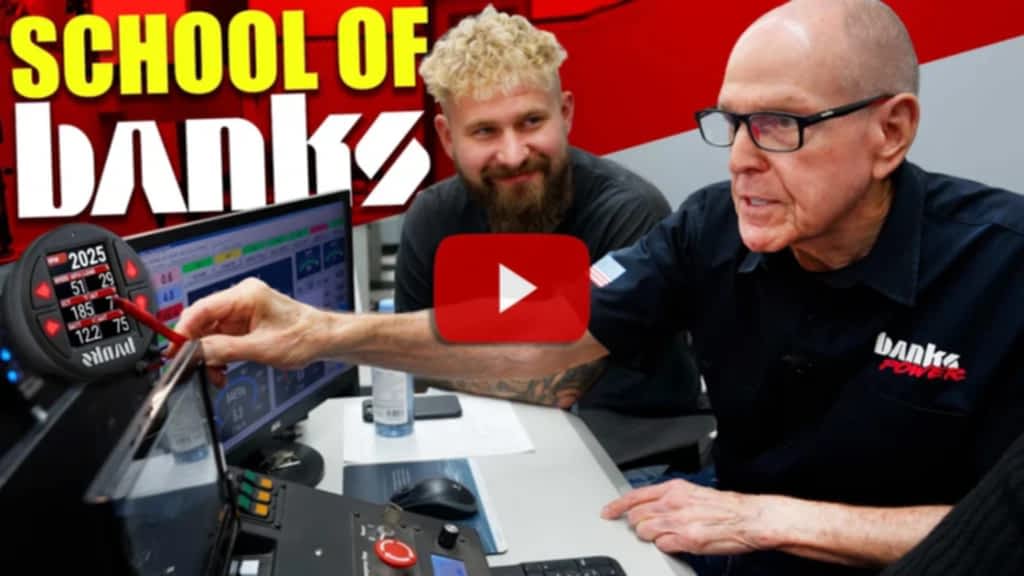
00:01 I’m Gale Banks and this is Kyle from Dark Iron Diesel. He’s a mechanic and YouTuber from Saskatoon where temps can dip as low as -40. He reached out to us last winter to let us know he was having difficulty starting his truck without a block heater. We discovered that his delete tune
00:19 was to blame, but during our research, we found our Canadian friends wanting more cold starting heat. We answered the call by developing several heating options for new and existing Monster Ram owners. What follows is Kyle’s visit to Banks. Guys, this is nuts. We have Banks. Banks. Banks
Meeting Erik, Gale’s grandson
00:41 over here. That’s Banks. And this is the main entrance to Banks. These guys pretty much have the whole entire block here. This operation is way bigger than I thought. Hello. There. Yeah, I’m Kyle. Nice to meet you. Your name? Eric. Are you Gale’s son? I’m grandson. Third generation.
00:55 Gotcha. So, you’re going to kind of give me a tour of the place. You’re the one giving me the tour. Yeah. Yeah. So, I figured first we’ll jump in, see some Monster Rams getting a You guys love the Monster Rams. By the way, everyone, this is Jay, your head of marketing for Bank. Yes,
Monster-Rams being shipped
01:06 sir. You have been a thorn in our side and also uh my best buddy. So, thank you. Yeah, we’re innovating products together. So, what you’re seeing are Monster Rams being packaged right here on the line. This is the line. When you open up your Monster Ram box,
01:20 this is where it came from. This is where it came from. Quite literally, this pallet that’s Those are all Monster Rams. These are monster rams. All of these lines right here are just assembling, hitting up monster rams. Why are they doing something monster? Mainly because of you. Yeah,
Hiding money in a Monster-Ram shipment
01:34 right. Guys, I’m boxing a monster ram for one of you and I’m going to do something special to this one. Make this look way easier when I do it, man. Guys, I’m not very good at this. Like, they’re barely hanging on. Just like that. Get a gasket. Yeah. So, we got our two gaskets and
01:51 one of these plates and then stack them on the side. Do I do anything with this? Okay. Shake it a little bit. Oh, it’s all gooey. It’s hot. Oh, boy. Okay. And now I got to put cuz this is expanding. Monster around. Just like this. Yeah. And I just kind of push it in there.
02:09 Then I get a manual. Wait for it to turn green. Yeah. Shake it up a little bit. Feels good on my hands. And then all I had is $25 Canadian on it or on me. So I’m going to Do I have some tape right here? I’m going to tape it to the wall like this on this side. And then I’m
02:31 going to write Kyle was here. If any of you guys get this, send me a DM on Instagram and I’ll send you a free hoodie. That would be so funny if one of my followers actually get this monster round that is packed up. Pretty not that great, but that’d be funny. Okay, so now I close this.
02:55 Boom. Good to go. And she’s in the pile. Again, if one of you guys get that 25 bucks, shoot me a message on Dark Iron Diesel on Instagram and I’ll send you a free hoodie. Here
Tube shop
03:03 we have one warehouse. I’m assuming judging by the exhaust here, this is kind of like where you build exhaust. Yeah. So, this is manufacturing. So, we’ve got our kind of CNC corner, if you will. So,
03:15 uh CNC lathe, CNC mill, some manual machinery, and then we got overflow from the tube shop. So, we can jump right over and look at our latest and greatest tube bender. We do the vast majority of our tubular products in house. And all the 5 in is done on this machine. 6-in bender can bend up
03:33 to 6 in 304. Oh, wow. Very, very strong machine. And we’re building 400 series 5 in on here. So you have all your different dyes, your wipers, your mandrels. And so ultimately what it’s going to do is just use a huge amount of force, bend a tube extremely accurately, even account for things
03:48 like screen back. So you overbend it, the material settles and makes for a very, very accurate 5-in system way up to a full 20ft stick from the mill. So we’ll trim them down to size, bring them here, do two, three, four bends, whatever it takes, and out of here they’ll get deburred, welding,
04:04 upswed, and we’ll take a look at the rest of the processes. But this is just step two. So here we’ve got a number of stamping dyes. So if you’ve got an exhaust section that goes and nest over the top, this is cutting reliefs in it. So when you go and actually put an exhaust clamp on it,
04:17 it can deform and grab it. So this giant stamping press is just giving reliefs for that, too. How old is this thing? Cuz like, guys, look at this thing. Like there’s no way that’s a modern technology. And some of this we got out of uh World War II uh era machinery that
04:32 that old warehouses were selling, but still works like a cop. Oh, yeah. A huge selling point of our headers is we have very thick 5/8 flanges. And so what most guys do is they’ll they’ll weld it all
04:42 up. The flange will warp like crazy and they just throw it on a belt sander. You’re like, “Oh, it’s good enough.” So what we do is after it’s welding, it warps to what it is. You always have a little
04:50 bit of warpage. And so you come in here, this entire thing is a pneumatic clamp. It clamps down on this giant long tube B10 header and it goes and runs through. It’s got a big 6-in tool head and
05:02 it’ll go and actually do a surfacing pass. And so that thing is perfectly flat, seals beautifully, and it’s it’s what we do to all of our headers. So everything is perfectly flat even after welding.
05:11 I know Gail’s really adamant on everything being like perfectly level. You’re not getting any leaks or anything like that. Yeah, we hold it to a very high spec. Some boost tubes in process. So these
05:21 two giant machines are eentric end formers. So what’s happening is we’re taking a tube. So this has been bent. It’s been cut to size for a boost tube. And what we’re taking it and we’re going and forming this bead. So, this allows uh a silicone boot to come over. You put a T-bolt on it and
05:38 that’s going to seal up against this bead. And so, what this machine does, you come in, you clamp the tube, and that’s an eentric roller. So, it has the profile and it slowly rolls outward and outward
05:47 and outward and builds the builds the shape into it without deforming it. Man, this is crazy. Like, you have so many of these things in here. That’s nuts. After the exhaust tubes are bent, they’re the exact same diameter. And so you have to make one of them bigger or smaller. If you want
06:01 to make it bigger, this is an upswedge tool and it’s got this taper and these fingers will grow outwards and actually expand that exhaust tube so they can nest over the top of each other. And then once you have the release, you clamp it and they they nestly and there’s not going to
06:13 be any any leaks. Seven welding stations, three more on the back side. Our smaller two benders over here. So these are kind of the old school machines that still work great. Gotcha. Some more manual approaches to bending and everything. So le less control, but it still works if you know
06:27 what you’re doing. Yeah. So, a lot of these guys here, these ones rely a little bit more on the the tax operating it. Yeah. And some of these guys have been here 20 plus years. They’ve been running this day in and day out. So, they know how to use them. And if it’s not broke, don’t fix it.
Warehouse
06:38 This is just completely full of raw goods ready to be packaged. So, exhaust systems, headers, boost. This is crazy. Look how far down it goes. This is one of two. This is This is just for our our large
06:50 components, as we call them. And it’s just stacked up. And look at all this stuff. That’s nuts. So, like a lot of these are ready to go, right? The boost tubes will come in raw. We’ll get them shipped out, get them powder coated, and our guys will wrap them back up, put them away, and these
07:06 are ready to get packaged. There’s a lot of stuff here, man. That’s nuts. It’s a lot. Of course,
Installation Center
07:10 everything that we sell, we offer installs. Oh, so you guys actually like you like local people in California can bring their trucks here and you’ll install. Oh, yeah. Not just California. I mean, we
07:18 we’ve had guys drive down from Alaska. I mean, all over the states to have our stuff installed. So, you actually have mechanics that work for you? three full-time guys installing nothing but our
07:26 parts. And I think right now we’re averaging about six monster RAMs a day mixed in with all of our
Research and Development
07:30 other stuff. This is research and development. So we have all of our grinding tools. Uh machining, fixture table, plasma table, all of our hand tools are out here. Two post lift with our uh infamous
07:42 project trucking a World War I era hot V aircooled British tank engine. And so Jay Leno came to Gale
Jay Leno’s Tank Engine
07:50 about 20 years ago. He had one of these in his what he called his tank car and he felt it was too slow. So he wanted to turbocharge it. And so we sourced a sister engine which is why it’s still here. Developed a full EFI Bosch controller twin turbocharger and put that back in his tank
08:07 car. It’s some 50 ft long ridiculous thing and I think close to double the horsepower on it. That’s crazy. But it’s a 27 L V12 air cooled engine. Air cooled hot V. So, intake manifolds on the outside
08:21 of the cylinder heads, exhaust on in the valley. Yeah. I don’t even know what a hobby is. Uh,
Engineering
08:25 so all of our Emmys in here designing mechanical parts. Uh, we got six 3D printers. So, as the guys are iterating, changing the design, test fitting, we’ve got 3D printers. A lot of 3D printers. Yep. Their engine build area. So, a lot of overflow parts, takeoffs from different engines. Ew.
08:42 Gross. Yeah. I don’t like those. This is a twin turbo small block that got pulled out of storage. We have uh some stuff in the works for that. Can’t talk too much about it. Our engine build area. Uh
08:55 this is a 630T. So very very similar to what would be an EcoDiesel from Stalantis. Um this one we had uh a runaway condition on this engine. So this was getting torn apart uh to see the the damage. North engineering north toes there. So that was Emmy and powertrain. Now we’re stepping into
Chassis Dyno
09:15 electrical engineering and test group. So, we’ll come back to our engine dynos, but what you hear outside that noise, those are our fans going for a chassis dyno. So, whether we’re baselining trucks, fingerprinting brand new trucks, testing competitor product, validating our stuff,
09:28 we always test it on the truck on the chassis dyno under the conditions we expect the truck to see before we do any sort of road testing. We got a 2018 L5P. It’s on our stain chassis dyno. What you hear is the cooling fans. The fans are running underneath, pulling off the Eddie currents,
09:44 and we’re loading up the truck. And right now we’re just going through some uh tuner testing for our Daringer doing some validation runs. And that’s Gail’s famous car wash dryer fan setup. We found those rusted in the side of the field. Clean them up. Did a custom G metal housing to be
09:59 able to aim the air where you want it. That’s simulating 60 mph wind. So before we jump in,
Electrical Engineering
10:05 I think the biggest differentiator uh for guys in our market is that we are doing everything in house on the electronic side. So hardware, software, firmware, everything’s designed in house. We have a full team and even assembling eye dashes is literally four miles down the road. Oh,
10:18 really? We just send it down. Outsource electronics to other countries or anything. Nope. So, we got a full lab back there to do prototypes. The full team. We’ll take you through it. Feel like we’re disturbing everyone here. Firmware team. We got a couple of hardware guys through
10:30 the hallway over here. Uh doubly lab. So, where all the prototypes are harnesses validation? All of our testers are done in house. And we’ll jump you over to uh Rick’s office. He’s working on some
10:40 testers right now. What do you got going on? Can I even film any of this? Uh you can um so this is a future design uh that I’m working on. Um I also do a lot of uh testing and evaluation. Um so I
10:53 I kind of work at the other end of the designers. Uh they design and then I validate and test and I also examine any type of failures or troubles and that kind of stuff. This this is great fun. If you
11:04 love puzzles, I think like you know like blowing up a truck on my dyno like that’s fun. like this just makes me I I got I can a lot of respect for you for doing this kind of work. Like that’s very
11:16 tedious. I like hard crossword puzzles and it’s very very similar to this mindset of figuring out how to lay out these boards and make it work and all that. Well, this is an eye dash right here.
11:30 Here’s the eye dash. I was just looking at it under the microscope. That’s cool. So, there’s one side of it. There’s the other side. Mhm. You see the processor. Yeah. This would be the back side
11:40 where you plug it in. Yeah. So, there’s the all the interface chips and uh processor and Bluetooth module, all that kind of stuff. Ready? Uh we skip right past it, but do you want to see an engine
11:40 run on an engine dyno? But we have two engine dyno cells. We’re going to go check out cell one in a
HMMWV Hybrid Engine
11:48 second. We got cell 2, which was also configured for high voltage. So, essentially what happened is they wanted to repower the Humvee. There’s 100,000 Humvees in the field. Uh, everything has an antiquated 6.5 liter non-turbocharged diesel engine that they designed in the 60s and they
12:03 just kept doing it because it it worked for them. The problem is there’s 100,000 Humvees in various fields around the states. Uh, they’re just sitting there and short of just scrapping all of them, they wanted to repower them, allowed us to take a Humvey to Irwindale Speedway, put in silent
12:18 only and drive around in an armored Humvee with no engine noise. And so during the test period, we had to go and test a high-voltage engine. uh or excuse me, an engine coupled to a high voltage
Emissions Lab
12:28 motor and we had to throw in 600 volts. And so we upfitted this cell with a battery emulation. So instead of having a giant thousand lb battery, we have an emulator that’s using city power. We skip
12:39 past this one. Actually under this is uh we call it our emissions laboratory. What this allows us to do is essentially get an idea of our emissions changes. So, of course, we’re going through carb.
12:48 We’re going through uh the EPA on all of our products and proving that hey, we are not worse or in sometimes case we’re even better than what OE and this is like what you would use to like get um
12:59 50 state compliance or it’s it gives us an idea. So, what they would want to see is like a full lab um equipment that’s millions of dollars having like air conditioned room for it. So, what this allows us to do, it gets very very close on a portable system and says, “Okay,
13:14 we’re heading in the right direction. Now let’s send it out to get shipped or send it out to SEMA Lab or to Carb and have them test. So here we’ve got our dyno control room. So obviously cell 2.
Engine Dyno Rooms
13:23 We got a newer AVL system. And over here we got our superflow system that’s rigged up with a 7.3 L Ford Godzilla engine. This is just a straight up 73 crate engine. So stock manifold, stock Y pipes. We went as far as putting the cat converter here and the OEM muffler. So it’s it’s
13:41 full OEM, full emissions. Here we’re looking at the motor home-specific intake. That’s why it looks a little funky. This the water absorber all the instrumentation blowby meter cooling and then of course instrumentation to the 9. I mean you might be familiar with our four-channel
13:55 modules. We’ve got a handful of you have over there. We have more in cell 2, but that’s just all the standalone instrumentation. So we have a mix of canvas values. So we’re reading directly off the ECU. And then of course we have all of our standalone instrumentation. So pressure,
14:09 uh temperature, pulse with modulation. I mean, you name it, it’s on here. So that way when we change one parameter at a time, we know exactly what’s happening. We know what to expect. And all of
14:19 our development is is very data heavy. But that’s what Gail loves data. Yeah. So even as far as, you know, adding our own thermisters into the intake track to see what kind of deltas you’re getting
14:29 in the intake system to blowby meters to take a look at what are we expecting for actual blowby and stock configuration. I mean, we we do not take any shortcuts when it comes to data accumulation.
Meeting Gale Banks in person
14:40 Apparently Gale is actually going to run me through some engine dyno. You got a treat coming at you. Okay. And I’m not going to lie to you guys. I actually did run into Gale, the man himself right here. I ran into him earlier. We weren’t recording when I did. So,
14:52 for all intents and purposes, this is officially meeting Gale on camera for the first time. Shake your hand. Nice to meet you. Did you bring the cold? It’s cold out. It is. It’s not as hot as I thought it was going to be here. But what do we got on here? This is that. This is
15:09 the Godzilla. This is a Godzilla 73 gas. We were just setting up to measure manifold air density drop. The air density from the ambient at 101.5 in the dino cell. Mhm. To the outlet on the uh cold air intake and then in the intake manifold, which is where it counts. Gotcha. So,
15:32 how do you start it up? Right here. You can start it from here. Yeah. Uh once we get it running, I’m just going to put my camera down cuz we got other cameras rolling here cuz I want to actually be able to focus on what you’re doing cuz I find it interesting. So, first the blowers fuel.
15:49 Oh, that’s you got to press the button on the computer and now the engine’s running. That’s cool. I’m going to put this camera down so I can focus on what’s actually going on. And this is all about density and intake temperature, pressure, ignition timing out of the ECU,
16:04 mass air flow. That’s also ECU. Yeah, that’s ECU. Engine oil temp, engine coolant temp in Fahrenheit, air fuel ratio on both sides, which is right at Stokometric, 147, 146, both sides. We’ve got O2 sensors in both banks of the engine. Right now, it has a motor home calibration.
16:24 Yeah, they were saying cuz it’s got the motor home intake on it. So be like if you had like a what are they called? Like an E450 are they? They’re still called F350. F53. Okay. F53. And they’ve been putting this engine in for about 5 years now. Anyhow, we’re going to make a poll here. We’re
16:42 going to look at how efficient the whole system is at the horsepower peak. So is this totally stock right now? Factory like Yes. It’s just catback right now. We have a prototype muffler on it. Gotcha. So, it still has the catalytic converter. Yeah. The cat’s in the dino cell. Okay. So,
17:00 this has like What kind of brake does the engine dyno have? Like I know my chassis dyno has an Eddie brake. This is a water brake. So, right now we’re throttled. So, see the manifold air density that’s at the top 70. That’s because the throttle is pulling us to this level and needs to power
17:17 up. Well, the density is is that cuz it’s getting warmer. It’s going down. Well, what’s going down? Yeah, it’s getting warmer, but watch the variables here. The pressure in there is 9.7 PSI absolute.
17:31 Mhm. That’s actually below ambient pressure and ambient pressure is more like 143 144. Yeah. So, what are you Aaron? What are you doing with your like what’s your left hand? So, we’re running speed alpha. So, this is uh accelerator pedal. Okay. Yeah. And then we’re running in speed
17:47 control on the dyno. So, is that your like cruise control? Essentially, it’s engine speed. You can request speed or another way to do it is with a different ECU would be request torque. In this case, this is a speedbased control system. And horsepower output right now about 60 horsepower,
18:09 less than 100 pound feet of torque. So, that’s what it’s putting out right now. That’s what it’s doing right now. 3200 RPM. And the coolant temp and engine oil temp are both right at 190 fah. So I should be pretty much up to temp. So I’d like to pull 3,800 watts. 3,800 full and then maybe 4,000.
18:23 Okay. So there’s 3100. Yep. Okay. where the throttle is all the way open. See the density? Yeah. So, that intake system could be perfected. I don’t want that much drop in the intake system.
18:56 But you want that to be over 100. I want that to be Yes, I sure as hell do which would bring this up and it would bring the power up. Currently, we’re making 347 3 Yeah, 345. call it. So you can 475 torque. You can just hold it and get a steady
19:16 reading of the horsepower. Yeah, absolutely. So you have the throttle maxed out right now, but you’re holding it back with the dyno. So let’s go to 4,000. Aha. The horsepower peak is where I thought it. Let’s go see the horsepower drop and
19:38 the torque. Yeah. here. You lost like 30 25 horsepower, but it’s starting to cut fuel. I think I think what it’s doing is it’s cutting throttle. It’s cutting throttle. Oh, yeah. That’s right. In this program, let’s pull it back to 3,800. Watch this number. Oh,
19:57 you had 360 there. Well, let’s bring it back. Got to get it stabilized. Oh, great. Read it. Gotcha. Okay. That’s so cool. So, you can really find its peak. 39. Let’s go. Let’s go to Yeah. You want to try 39? See, that might be it right there. Don’t you think? Yeah. 3900 some horsepower feet.
20:24 Just the hell of it. Let’s see. 3700. So, we’re over 350 at 3,900 RPMs. Oh, yeah. You’re down. That’s 3,700. So, we’re bracketing. Yeah. So, it’s 3900. If you go to 4,100, we’ll see the throttle
20:46 cut. Watch this. Oh, yeah. See that? Yeah. That’s crazy how much difference is closing the throttle. Look at the density. 81. Okay. Now, bring it to 3900. See the throttle open. Yeah. And the air
21:04 density went up. Yeah. like a massive amount. Yes. So, they’re controlling the power in a motor home port is by closing the throttle above 3900 RPM and you can see it’s, you know, the ECU sees the drop in mass flow, it pulls back to fuel flow. Yeah. And it’s a governor. Yeah. I just think
21:27 that’s so cool how much of a difference it makes when you, you know, from 3900 to 4,000 to 4,100 and you can actually watch, but you can really watch it here. That’s you can see the power fall,
21:39 but why is it falling? Because of the air density. Because you’re starving it for air density. Yeah, you’re throttling the engine. It’s cool how they go hand in hand with So, as I said a little while ago, the density the throttle is the density control. You just saw it happen. Yeah. just
21:56 for the helmet. Let’s take it to uh 4100 again and see what happens. Watch the air density drop like crazy. Yeah. There we go. So much. Isn’t that something? Yeah. So 55 lb versus 73 per,000 cubic feet. That’s throttling. That’s crazy. Yeah.
22:22 If you don’t have this on your dyno, then these calculations, the Dutron doesn’t do this stuff. It won’t do the calcs. It’ll measure the the values, but it won’t do the calcs. But the dash pro will do the calcs. Absolutely. It does the calcs along. This works on a diesel. There’s not a throttle except for EGR purposes, but you guys
22:38 are removing all that. So, there’s no throttle, but the density will still come down if you have a fuel cut. The air follows the fuel in that case. I actually have a coworker named Scott. So, Scott,
22:49 I know he watches my videos. He likes your videos because you’re so about the data. and he’s one of those data guys and he’s always talking about air density this and I’m kind of like yeah yeah yeah
22:59 like whatever and stuff but like actually coming down here and like let’s letting you explain to me and like seeing it firsthand. It’s pretty cool. Like I definitely want to start experimenting more on my dyno with it. But while I’m here, we got to look at the monster rounds. Okay,
23:12 let’s do it. Cuz like that’s the whole reason why I’m here in the first place is because of the monster rounds. Let’s have a look. Hey, look at all you got everything lined up here. We got
Air Density education with Gale Banks
23:19 stock. We got a Banks Banks with what? This one has one heater coil, two in there. You got all the different variations going on right here. Pretty much. Yeah. So, you’re going to talk you through. We’re going to have a look at them. These are cool. I like how you have them all lined up like
23:33 that. It just It just looks good. It just I like the I like everything orderly. Yeah. You know, we did a cutaway of the stock setup. This is the worst piece of automotive equipment I’ve ever seen
23:45 in my life. Forget the grid heater for a minute and the failure killing the engines. this thing as an air flow device. It’s like a throttle that’s partway closed. You lose a lot of air density going through this thing. To get any boost level, the turbo has to work harder. Yeah. So, you’re
24:03 wearing out your turbo faster. Well, yeah, but it’s if you got a boost loss through this thing, you’ve got a density loss through this thing. The turbine has to produce horsepower to overcome that to get the density you want the intake manifold. M. And that being the case, when you
24:20 go to something that really flows beautifully, unloads the turbo, the drive pressure into the turbine drops. Mhm. It’s still reporting the same temperature, pressure calculation. You know, you got IAT and uh manifold of air pressure. Yeah. They’re coming up with the density. Yeah. uh those
24:44 two numbers as we discussed in the dyno room. Bottom line here, you’re unloading the turbine on the turbocharger and the shaft speed is lower because the compressor doesn’t have to spin as hard cuz you remove that thing from the intake tract. Gotcha. It’s between the compressor and
25:00 the intake manifold. So, you get that the hell out of there. Now, now you’ve got almost no loss whatsoever and a way better distribution into the manifold itself. Mhm. And then we just recently redid the uh from the billet manifold cover, we went to a high-pressure cast manifold cover. And
Monster-Ram Dual Heat and Billet Heater kit for colder climates
25:21 you remachineed this so it flows better. Oh yeah, we make And you push this in so there’s more volume. We raise the roof so you got a bigger section and it turns the corner better. Yeah. By doing this short side radius rather than having a square corner there like on a billet plate.
25:37 But you know what my favorite part about what you did with this now is you put these spacers in there cuz that was just annoying. Those loose mothers drive you nuts. The little nuances that we throw in and the fact that these are part of the plate. Yeah. It makes it for a better install and
25:54 I just think it looks clean. It cuts time out of the install and it looks better. Yeah. The main thing though that we’ve done recently with the Monster Ram is the dual heat. I I have a feeling that I may have had something to do with that. Probably made your life hell for a while and I’m
26:10 sorry. You stepped on my lines. What are you going to say? Yeah, I was going to compliment you. Oh, okay. I was going to apologize. Now I can’t compliment you cuz you already did it yourself. Wow. I was doing it more to apologize cuz I know your life was kind of No apology necessary. Every
26:26 place is not California. No. So, as much as we wish the weather was, the fact that our single heater is 750 watts with the block heat at -20F. Yeah. That they say in the owner’s manual, run the block heating. And to be fair, like I say, if it’s -10° C or colder, plug your truck in. Like
26:49 my truck is always plugged in, so it never been an issue. It’s more like a just what if scenario if your you break your uh breaker trips or somebody unplugs your cord, whatever it is. You know what I mean? You should have your truck plugged in. Yeah. But well, thank you for that. It can get
27:06 cold enough that the truck won’t even crank. Yeah. Let alone the heat. Minus 40 FN and C is the same thing. That’s where they meet. That’s where they meet. So, but at minus40, we got a no no start battery voltage. Yeah. down to like you’re not starting a truck at -40 without being plugged
27:25 in even like with a factory grid heater. Exactly. Yeah. Yeah. And we’re looking at our data from the cold saddle and we’re going to do a video on what we found. But we instrumented coolant temperature and sump temperature. Yeah. So even with the block heat, I got to look at the data and see
27:44 how much that brings up oil temperature. Yeah. So, if you guys didn’t know this, they actually because of this whole thing rented a cold cell so they could simulate Saskatchewan weather in California and that’s how they developed this new kind of upgrades to the existing Monster Ram or
28:00 the new design. Exactly. Which is awesome. And we tested all this stuff also. That’s cool. So, we we know what’s required in a 20 24 truck with about 8,000 mi on it. Stock truck. Stock truck. Yeah. But we put in the good uh Interstate batteries, oil, 540 oil. 540. We did We did all
28:26 new filtration. Uh but if you got an older truck, the injectors are kind of not too wonderful. Yeah. not atomizing real well, starter’s kind of worn out, whatever. Yeah. Uh it might require some more blocking. But you get to a point where the battery temp even with those interstate batteries
28:46 comes down to where when you go to start voltage drops, ECU ECU turns off. Yeah. What do you need for an ECU? 10 volts is Yeah. Yeah. 9 10 somewhere in there. They fall off the edge of the world.
28:59 Yeah. So you ain’t starting anyway. Yeah. because you don’t even have enough volts to run your So this minus40 starting at minus40 I never tried to start my truck at minus 40 either by the way I’m
29:11 gonna tell you with glow plugs we’re able to start at minus40 with our Duramax based military engines we’ve done it so this is the original monster this original uh we’ve come out with the dual heat so
29:26 for the guys that have the original we came out with a billet second heater Yeah, that’s nice. It works very well. This is my first time seeing it. And you have the dual, right? So, if you want,
29:39 you can put two heaters in. Yeah, we kind of got a lot of single heats out there. Boom. A lot of guys are buying the dual heat as a single. So, when you buy the dual heat, it comes with two plugs.
29:52 Yeah. And a single heater. Yeah. It’s dual heat capable. If you want to go to dual heat, then you you buy the second heater. This is the same price as this was. Mhm. It comes with a single heater,
30:06 a lot more machine work, new all new tooling and a and a patent pending. Mhm. For all you copers. Anyhow, this guy, we’ve got the little jumper that comes with it. Uh goes between the two. Yeah,
30:26 it goes right here. Yeah, that gives you dual heat. Now, this is a single. So, this could be a configuration if you had the old monster. Yes, you could run a two. You could do this two heater. Yes. And one up at the top. Yes. And this kit is what we’re looking at. The dual heat
30:44 has a MAP sensor relocation kit and the cable. And of course there’s a ground strap. Oh yeah. Electrically it’s bulletproof. Mhm. And then if if you’ve got a guy who wants to go nuts. Do you have a is a single in that one? This is Oh, you got four. Yeah. That’s the ultimate like I live in
31:04 the North Pole where the Yeah. And we still have to deliver presents. Yes. Okay. So, this is the original one. We got 750 W heater and another one. So, this one’s got 1500 watt of heating. Yes. This one is also 1500 watt. This is the new style. So, you can have them both right there. Then we go to
31:18 You could call this an old style if you just had one heater in the middle. Dual down there. So, what is that? 2,00 2250. Yep. watts of heating. And then this is I’m going to test this out. I don’t I think this is overkill, but like what’s that? 30,000. That’s 30,000. 3,000. You know,
31:37 good, better, best. I don’t know. Yeah. I I have a feeling that for me and my application, like with plugging my truck, and I think two will probably be fine, but I might run three just for those emergency situations. I think I’ll probably end up doing two here. And then I’ll just run a
31:55 single down here. I don’t want to put three up here. And I also feel like then you’re kind of like sucking in some already warm air. Well, I do really appreciate you like actually kind of working with like Canadians, you know? Well, cuz you could have taken an approach where you could
32:10 have just, you know, like a lot of companies probably would have. Oh, this guy doesn’t know what he’s talking about. I don’t. But, uh, this is awesome. This is really innovative and and I think it’s going to be great for I don’t prejudge like that. No. No. That’s good. You know, I mean,
32:25 what we just just did in the dino room, I like to teach. Yeah. I get a kick out of it, it just does something for me. Yeah. When I see the light go on. Yeah. You know, you can see it in your eyes. Yeah. And I went, man, he’s getting this. Yeah. This is worthwhile. Yeah. Okay. Well,
32:44 thanks, Gale. I appreciate you taking the time to meet me and have your guys show me around and show me the dyno cell and all that stuff. My pleasure. I like and I appreciate working with me on the
32:56 Monster-Rams and I’m looking forward to actually well I’m not looking forward to it when I go home it’s going to be cold so we can start actually kind of starting to test these things out and see what works best for somebody that lives in Saskatchewan like myself and I’ll let you know
33:08 about the cold cell. Yeah. And yeah I’ll give you the report. You’re going to put out a video on the cold cell? I am. Nice. Yeah. I’m looking forward to that one. That’ll be I’m looking forward to you guys and seeing how you guys act in the cold. You’re probably, “Oh, it’s so common.” Like,
33:23 man fingers. Anyways, I really appreciate you having me here. This is really cool to see everything. I look forward to seeing what you come up with in the future. That was my honor. Thank you. It looks like things are going to get real cold real fast. If you want more heat,
33:38 head to bankspower.com today. I can’t pay my fingertips, so I’m ready to get out of here.
“I had no idea how huge Banks was,” says Canadian Diesel mechanic and YouTuber, Kyle Redekopp. “So many buildings… so many engineers. I assumed everything was outsourced. But they make it all right here. I have a whole new opinion of Banks.”
A year ago, Kyle (aka Dark Iron Diesel) contacted us about his ’22 RAM 6.7L having difficulty starting in extreme temps without block heat. It turns out his delete tune was to blame. But during our research, we discovered our Canadian friends wanting more cold starting heat. Having jump-started our heating journey, Kyle left Saskatoon’s sub-zero temps to visit Banks in sunny Southern California.
Kyle didn’t just get a campus tour, he got an education in air density and cold starting from Gale Banks himself.
Kyle from Dark Iron Diesel visited Banks Power to see how performance products move from engineering and testing into manufacturing, installation, and shipping. The tour included Monster Ram production, in-house tube bending and welding, the installation center, research and development, chassis dynamometer testing, and Banks’ electrical engineering team.
The visit also connected directly to the cold-start challenges faced by Canadian diesel owners. After investigating Kyle’s truck, Banks developed additional heating options for new and existing Monster Ram owners. The result is a closer look at how real customer problems can lead to product development and testing.
Learn more about Banks Engineering, explore the company’s history and capabilities, or browse Banks’ engineering projects.
Related Cummins Cold-Start and Monster-Ram Articles