



Many believe that upgrading the intake elbow on RAM will not improve performance because the Cummins 6.7L cylinder head limits airflow. They’re wrong. Here’s the proof.
00:00 I read all your comments. I’d like to reply to all of them, but frankly, I got I got work to do, but some of them are so outstandingly wrong. I’m afraid it’s infecting the pool. Anthony, regarding the monster ram, the bank’s monster ram writes, “It does nothing. The head is
00:22 the major restriction.” H Okay. And then we’ve got Casey who appears to be leg humping Anthony. I guess people don’t get it. Okay. To which Anthony replies, “Stock intake horn outflows the stock head.” How do these guys know this stuff? And my last one here is Travis.
00:42 The head on a Cumins won’t even flow 250 CFM. The stock horn is well over that CFM. So even if you change the added CFM means nothing. The head can’t flow more than the stock horn will allow. Look it up or ask a mechanic. Okay, here’s a mechanic right here. First of all, the stock
01:09 Cumins displaces or pumps 331 CFM at 2800 RPM, which is the horsepower peak. You performance guys are probably spinning the engine a little faster. Somewhere in the neighborhood of 3,400 RPM or more. And with enough turbo, you can easily flow more than a,000 CFM. So, how do I know
01:32 that? The flow bench. Now, the flow bench isn’t a turbo, but you’ll get the idea. Flowing through a bank’s monster ram, the stock head flowed 750 CFM, which is not the limit of our monster ram or the cylinder head. It’s the limit of the flow bench. While the head is a
01:51 restriction, it’s not the restriction. If it were, upgrading your turbo or intake elbow would have no effect. But they do. Myth busted.
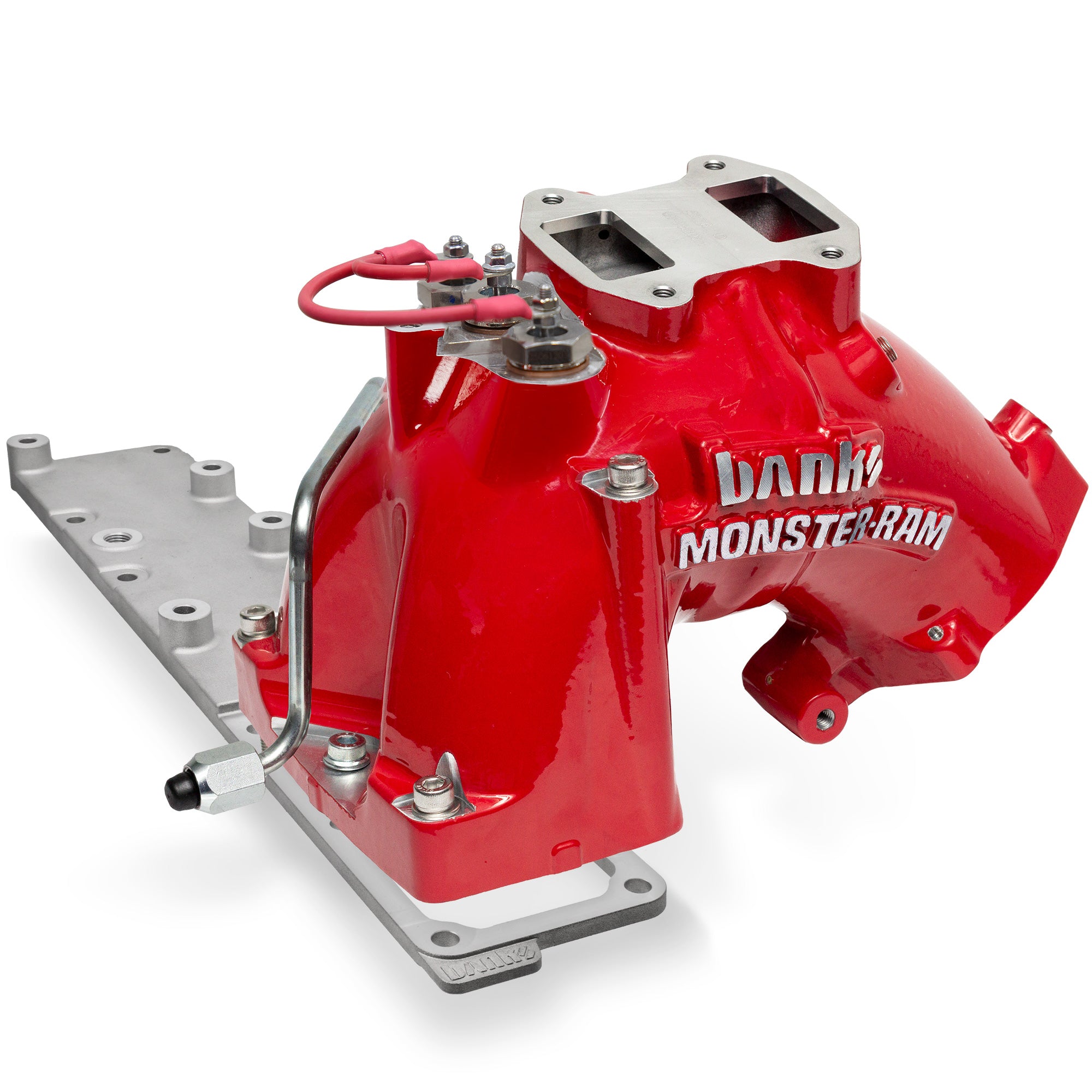
Fluid dynamics dictates that when air travels through an engine induction tract—from the airbox, compressor, charge-air cooler, and intake horn, down through the cylinder head intake ports and past the valves—every component acts as a discrete flow restriction connected in series ($\Delta P_{total} = \Delta P_1 + \Delta P_2 + \Delta P_3 + … + \Delta P_n$). The widespread internet claim that an intake elbow upgrade “does nothing because the cylinder head is the ultimate bottleneck” violates fundamental fluid mechanics. While the cylinder head ports and valve throats do represent the smallest cross-sectional flow area in the induction path, any restriction placed upstream compounds the total pressure loss across the system. By replacing the crushed factory intake elbow and restrictive grid-heater block with the 4-inch Banks Monster-Ram, total system pressure drop drops by 18.67%, immediately increasing the mass of air delivered into the cylinders.
The misconception that a 6.7L Cummins only needs 250 CFM stems from a basic misunderstanding of four-stroke volumetric displacement under forced induction. A 408-cubic-inch (6.7-liter) diesel operating naturally aspirated at 100% volumetric efficiency displaces 331 CFM of air at its 2,800 RPM horsepower peak ($CFM = \frac{Displacement \times RPM}{3456}$). Under performance conditions spinning at 3,400+ RPM and packed with 30 to 45 PSI of turbocharger boost pressure, the engine’s volumetric air consumption multiplies dramatically—easily demanding over 1,000 to 1,200 CFM of mass air flow. On the Banks SuperFlow flow bench, testing the stock cylinder head with the Monster-Ram installed flowed an astonishing 750 CFM, pegging the physical flow capacity of the bench itself and demonstrating that the head flows vastly more air than forum naysayers believe.
Reducing induction restriction delivers immediate thermodynamic gains across the engine’s operating envelope. When an intake horn and heater grid choke the inlet, the turbocharger must operate at higher pressure ratios to force the required air mass into the cylinders. Higher pressure ratios drive compressor discharge temperatures sharply upward, increase turbine backpressure, and force the engine to exert excess mechanical work during the intake stroke—known as parasitic pumping loss. By removing intake restriction, boost pressure rises at the manifold without increasing drive pressure at the exhaust turbine. The result is cooler charge-air temperatures, enhanced combustion efficiency, lower exhaust gas temperatures (EGTs), and verified fuel economy improvements under heavy towing loads.
Related Cummins Airflow & Engine Protection Articles