



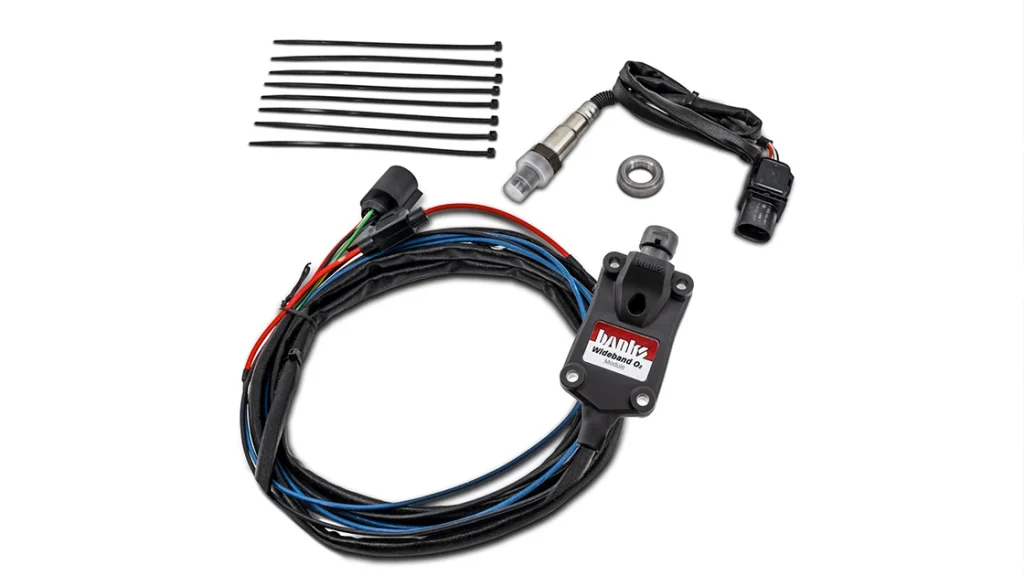
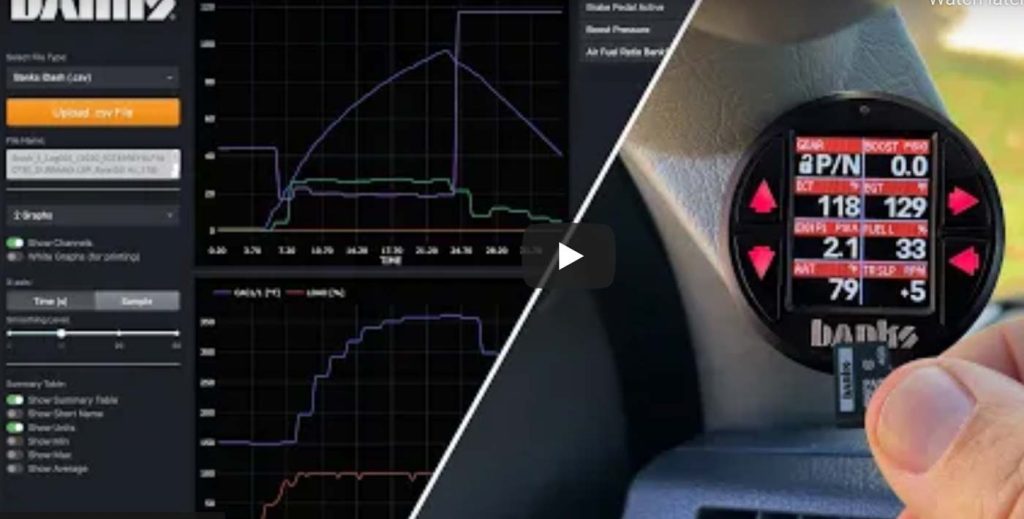
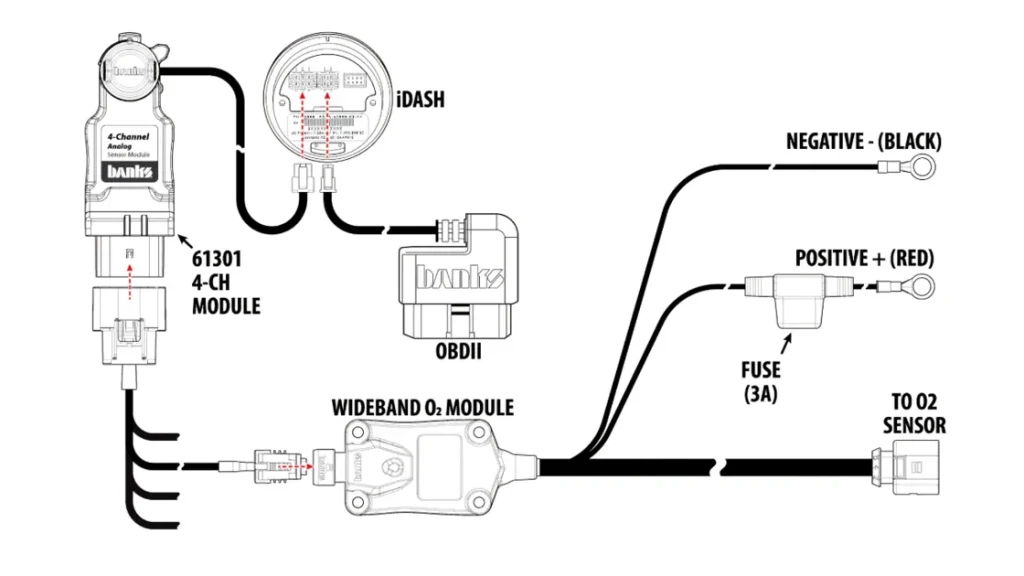
The new Banks Wideband O2 Air-Fuel Ratio (AFR) Module is an advanced sensor system designed to integrate into the iDash information ecosystem and accurately measure air-fuel ratio. It provides precise, real-time data, allowing for optimized engine performance, improved fuel efficiency, and reduced emissions. Data from the Wideband O2 Air/Fuel Ratio (AFR) Module can be monitored in real-time with any Banks iDash digital gauge, and when coupled with the iDash DataMonster or iDash Data Pro, can be recorded along with other engine parameters. Data can be played back on the iDash itself, or exported for deeper analysis using our free website datalogviewer.com or any data analysis tool.
Compatible with various fuels, including gasoline, diesel, ethanol, and methanol, the Banks Wideband O2 AFR Module is an essential tool in the Banks sensors and modules lineup for tuning or engine development.
Internal combustion engines require precise air-to-fuel stoichiometry to achieve peak thermal efficiency, maximum power output, and safe exhaust gas temperatures. Unlike factory narrowband oxygen sensors that merely indicate whether an engine is richer or leaner than stoichiometric equilibrium ($\lambda = 1.0$) through an abrupt 0.1V-to-0.9V voltage switch, a laboratory-grade wideband sensor utilizes a planar zirconia sensing element featuring an electrochemical Nernst cell and an active oxygen pumping cell separated by a microscopic diffusion gap. By varying the bidirectional electrical pumping current required to maintain zero net oxygen concentration across the diffusion cavity, the sensor measures exact oxygen concentration across rich, stoichiometric, and ultra-lean mixtures. The Banks Wideband AFR Module incorporates sophisticated digital signal processors and closed-loop PID heater regulation, maintaining sensor ceramic core temperature at an exact 780°C (1,436°F) to prevent thermal shock, eliminate signal drift, and deliver microsecond response during rapid wide-open-throttle transients.
Traditional aftermarket wideband controllers output analog 0–5V DC signals through auxiliary copper wires spliced into external dataloggers or firewall pass-throughs. This analog architecture is inherently vulnerable to ground loops, electrical noise from high-output ignition coils, and vehicle chassis resistance drops. A miniscule ground shift of just 0.05 volts corrupts an analog air-fuel reading by 0.5 to 0.8 whole AFR points—falsely indicating safe mixture when combustion cylinders may actually be running dangerously lean and detonating. The Banks Wideband AFR Module eliminates this hazard by converting raw electrochemical sensor currents into digitized engineering units directly inside the weather-sealed module microprocessor. This clean, digitized stream of Lambda, AFR, and sensor diagnostics is broadcast directly across the noise-immune Banks Bus (B-Bus) serial CAN network to the iDash display, guaranteeing total data integrity without ground offset corruption.
In modern multi-fuel environments—where engines transition between pump gasoline (14.7:1 stoichiometric ratio), ultra-low sulfur diesel (14.5:1), E85 ethanol (9.76:1), and race methanol (6.4:1)—tuning strictly by fuel mass weight creates dangerous ambiguity. The Banks Wideband AFR Module reports in both normalized Lambda ($\lambda$) and user-selected fuel AFR, giving tuners an absolute reference regardless of varying seasonal ethanol concentrations. When linked to an iDash DataMonster or iDash Data Pro, wideband exhaust data is recorded synchronously alongside critical powertrain parameters—including Manifold Air Density (MAD), calculated torque, throttle position, boost pressure, and ignition timing—at up to 20 samples per second onto an onboard microSD card. Calibration specialists can instantly analyze transient fueling on the gauge face or upload logs to DataLogViewer.com to eliminate fueling flat spots and achieve dyno-proven power.
Related Sensor & Instrumentation Tech Articles