



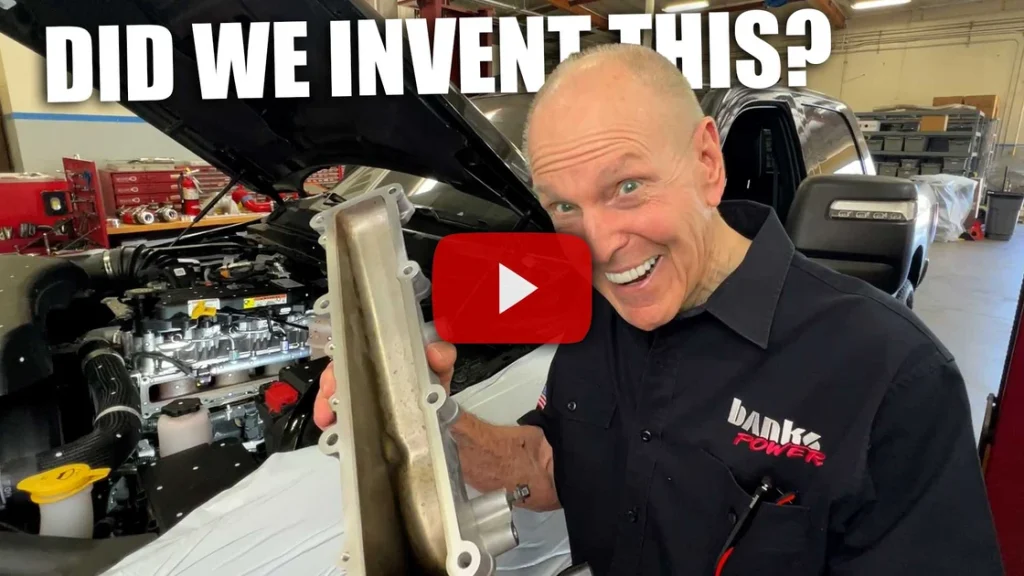
Gale Banks pioneered the side draft intake manifold for the Cummins 5.9L to set a land speed record. Now he’s bringing it back for the RAM 6.7L. It’s such a well-engineered design that Cummins is using it on the new 2025+ engine, so look forward to a better breathing engine and some real performance improvements. See how it all happened above.
00:00 Look at this. 25–67 Cummins. One side draft manifold extracted. It’s hard to imagine—I came up with this 24 years ago. This was around ’01, and I ran across a guy named John Stang. Turns out John Stang ran the Cummins Skunk Works back then.
00:24 Cummins stock was like $27 a share. It was extremely low. They needed a shot in the arm. And I said, you also need younger stockholders. How about making Cummins stock kind of in vogue? They were doing a common rail version of the 5.9 to come out in ’03. I said, “Man, that injection technology rocks.”
00:41 My evaluation was, why don’t we do the common rail? And we do it in a pickup truck. I found some records and thought, we can break these records if we go 210 mph. How do we get enough horsepower to set those records?
00:59 I wanted the thing to be streetable. I wanted it to pull our pit trailer—with all our tools, our workbench, our wheels and tires, our quick-change gears, all that stuff. They agreed, but they had no budget. “Yeah, we’ll give you a couple of used dyno engines.” They made about 404 horsepower. We put it on our dyno—402. Within a couple horsepower. So we knew we were in agreement with Cummins Engineering.
01:16 We started at 400 and change and decided this thing’s got an airflow problem. If we want to go further, we’ve got to do something about airflow. We looked at the intake manifold and went, “That’s got to go,” because we wanted to port those intake ports. We modified the head, designed casting for the Big Hoss side draft, and fabricated an exhaust manifold.
01:48 When we were done, we had 735 horsepower at about 3,100 RPM. Called up the guys at Cummins and told them. Their first reaction: “Oh, you’re bullshitting me.” That was the first engineer I talked to.
02:08 We put it in the truck, automatic trans, and drove to Bonneville. Drove onto the salt, made it a racer, and I was driving it to the starting line with a country radio station on. We broke the record on the first run, but it had to be a two-way average. Our best two-way average was 217. Our best one-way out the back door at the end of the fifth mile was 222.
02:25 There it is: the world’s first side draft Cummins manifold for a B-series Cummins 5.9. This is the record engine. I’ve decided to bring back the Big Hoss—specifically designed to fit the 6.7—and do it as a casting. I also want it to be affordable.
02:46 Cummins didn’t participate in the cost of building this truck at all. I did it because I was nuts for diesel. I still am.
The side-draft intake manifold was developed to address airflow limitations in the original 5.9L Cummins project. Gale Banks describes how the design helped support a record-setting engine while maintaining the goal of building a truck that could still be driven to the starting line and used to tow equipment.
The design focused on improving the path from the intake entry to the cylinder head. By changing the manifold layout and creating more direct airflow into the intake ports, the Banks team was able to support the airflow requirements of a substantially more powerful engine. The original Big Hoss project became an important part of Banks’ diesel engineering history.
This article also introduces the planned return of the side-draft concept for the 6.7L Cummins platform. The final production design, application details, availability, and performance results should be confirmed when Banks releases official product information. For now, the video provides useful context on the engineering history behind the design and why intake airflow remains important to Cummins performance.
Related Cummins Intake and Airflow Engineering