




“I love it!,” yells Nick Melton from the cab of his ’24 Duramax barreling down the highway. The North Carolinian was a Test Pilot for the new 2024 Duramax Ram-Air Intake System. “I don’t expect anything sub-par from Banks. The products have always been top-notch, and the Ram-Air for my ’24 is no exception. I’ve put cold-air intakes on dozens of trucks, but this is the first one that I can actually feel a difference. These trucks get terrible mileage, but with what’s being reported on the dash and what I’m recording by hand, I’ve noticed a mile and a half extra, maybe two, in fuel mileage gains. Every little bit helps.”
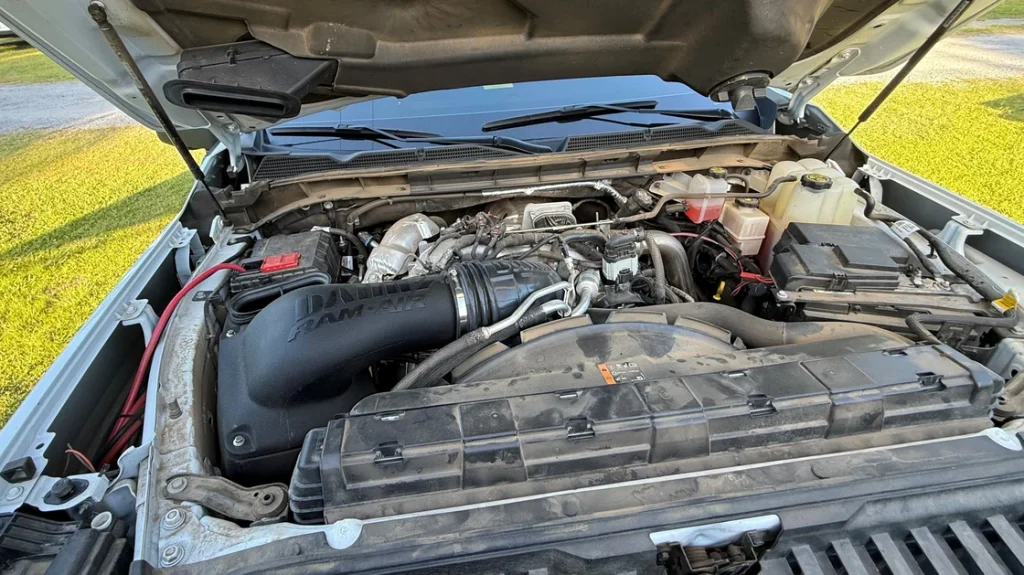
“Loaded and unloaded, I can feel a torque gain. On the highway, I can mash the throttle, and you can feel more power than before. For example, pulling away from a dead stop while towing 14,000 lbs., the truck really moves. You can definitely tell that the engine is able to inhale more air, and isn’t labored like before. The engine also seems to have a more pronounced growl to it with the Ram-Air. II’ve been telling everyone not to bother with any other intake, because this is the only one that delivers (explore all GM Duramax performance upgrades).”
When a heavy-duty diesel truck pulls a 14,000-lb trailer from a dead stop, the engine operates under severe, sustained load where peak mass airflow demand is highest. In the factory GM induction system, air must navigate restrictive acoustic baffles, sharp internal bends, and an undersized filter element. This creates substantial intake depression (vacuum) at the turbocharger compressor inlet. Because atmospheric air must struggle to overcome this negative pressure differential, the turbo’s compressor wheel is forced to spin significantly faster to reach commanded boost. By engineering an aerodynamically contoured, large-radius SuperTube and an oversized forward Ram-Air duct, the 2024 Duramax Ram-Air intake slashes pressure loss by up to 45%. This drastically reduces compressor workload, cuts parasitic exhaust drive pressure, and accelerates turbocharger spool off the line.
Horsepower, torque, and fuel economy in a diesel powertrain are fundamentally governed by air mass—the physical weight of oxygen packed into each cylinder charge—rather than simple cubic feet per minute. The enclosed EPDM airbox of the Banks Ram-Air system isolates the intake charge from hot underhood convection, drawing cool, high-density air directly from the vehicle’s high-pressure frontal zone. Cooler air possesses higher molecular density, providing more oxygen molecules per intake stroke to combust injected fuel completely. This elevated air-fuel ratio prevents unburnt hydrocarbons, lowers exhaust gas temperatures (EGTs), and ensures cleaner combustion. Real-world fuel economy increases (such as the 1.5 to 2 MPG gains observed while towing) occur because the engine extracts more kinetic energy per fuel droplet without requiring rich ECM compensation.
Enlarging intake duct cross-sections to increase airflow mass normally triggers check engine lights and limp-mode derates on GM’s encrypted Global B architecture, which continuously cross-examines analog and digital pulse-width-modulated (PWM) Mass Air Flow (MAF) signals. Competing aftermarket intakes compromise performance by keeping tube cross-sections artificially small to match stock flow limits. Banks solved this obstacle with the patented Air Mass Control Module. Operating as a high-speed signal processor, the module intercepts and conditions raw sensor data in real time, broadcasting the exact signal structure the factory ECM expects. This enables Banks engineers to deliver +58% more airflow mass through the filter with complete 50-state emissions compliance (CARB E.O.) and zero false trouble codes.