




Gale Banks:
If you’re a RAM Cummins owner, you may have heard about the dreaded grid heater bolt failure that kills engines. But what is it exactly, and how can you prevent it? I’m Gale Banks, and I’m going to show you.
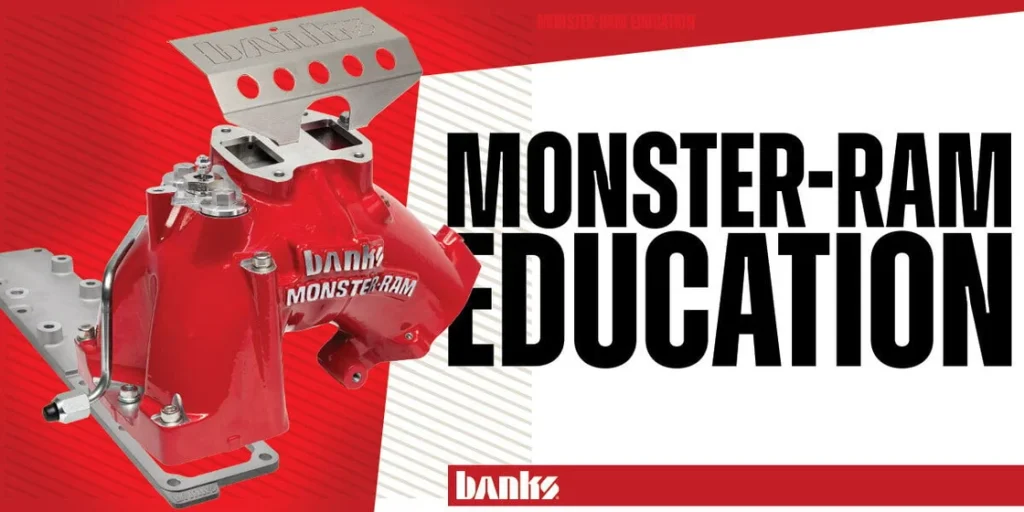
When we designed the Monster-Ram intake elbow for the Cummins 6.7L engine, our goal was to improve power and efficiency—and I have to say, we knocked it out of the park. We achieved an 88% increase in mass airflow compared to stock. That’s a huge gain that you can feel.
But what we didn’t realize is that we had also designed a device that prevents engine failure. With every 6.7L Monster-Ram comes a Banks high-flow billet intake plate. It replaces the factory grid heater. We did this for performance: the factory grid heater absolutely kills airflow. You can see the difference—our plate has no obstructions.
We also designed a coil heater that sits vertically in the Monster-Ram so we don’t leave our friends by the side of the road in the cold. But what we didn’t realize is that by removing the grid heater, we were also removing a point of failure. And when I say failure, I mean total engine failure.
To show you what this looks like, we’re heading north to Kamloops, British Columbia. Brad Hunt and his team at ProTech Diesel Center are the go-to guys for diesel repair in Western Canada, and he’s got a RAM in the shop right now suffering from the heartbreak of broken bolts.
Brad Hunt (ProTech Diesel Center):
Like Gale says, here at ProTech Diesel Center, we do a lot of Cummins repair, and we see quite a few major engine failures and engine replacements due to this one little bolt. As you can see here, this is a heater grid out of a RAM 3500 6.7-liter Cummins. Due to heat, condensation, and bad connection, this bolt has a tendency to erode, rot away, and fall into the intake runner, which then runs down the intake channel, ends up in the number six cylinder, and either bends the valve or puts a hole in the piston—or both.
So here we have a 2016 RAM 3500 with a 6.7L Cummins diesel. It has the infamous intake grid heater bolt failure where the bolt has broken and gone into the number six cylinder. We’re going to tear down the top of the engine, pull off the heater grid, and find out how much damage there is—whether or not we can salvage this engine and put it back together with the Banks Monster-Ram intake.
To show where the exact failure point is, you can see it right here: here’s the 10-millimeter bolt head and wire that goes to the grid heater assembly. As you can see, when I touch it, it is loose and broken off inside the intake.
We’ll start tearing this down so that you guys can see where the failure is and how Banks has come out with a solution to avoid spending potentially $20,000 to $30,000 on an engine replacement. I’ll introduce Hayden at this point, who is one of our technicians here at ProTech Diesel Center. He’s going to start the teardown process.
Hayden (Technician):
Done a couple of these. So this is your stock intake horn that Cummins has put on there from the factory. Right in here on the motor is where the grid heater is. The power wire going to the intake powers the grid heater that is underneath here. With the new setup that we have, this is no longer going to be installed; it will be a different style heater altogether.
This is the piece in question: as you can tell, that bolt has broken off. Here is the rest of the intake—this is supposed to be fixed to this, and it is no longer fixed.
Brad Hunt:
Now that we have this intake grid heater off of this 6.7L Cummins engine, there is quite a bit of carbon in here from the EGR system. Underneath, you’ll see it’s quite dirty, and you see here there’s a missing bolt. You have a nut right here that is in place 100%, and you look over here, and that nut is missing.
Flip the intake heater over, and here we go: the top half of the stud and plastic assembly has melted, corroded, and broken off. Now that has fallen from here and gone down the intake runner into the cylinder, and is either wedged in the valve or in the top of the piston right now.
A Banks Monster-Ram intake assembly would have prevented all of this from happening and would have saved this guy this very costly repair and possible complete engine replacement—which we’ll know as soon as we have the cylinder head off. Going to this coil-style intake heater assembly versus the factory 6.7L intake assembly will save you in the long run. It is a very good update.
Now that we have the intake off, we have to pull the valve cover, the valvetrain, injectors, EGR cooler, exhaust manifold, and then remove the cylinder head. Then we can inspect cylinder six to see if it is embedded in the piston or if it has scratched the cylinder wall—and if this block is even usable.
Brad Hunt (Inspecting Cylinder Head & Piston):
So now we have the cylinder head off of this RAM 3500 6.7L. As you can see right here, that’s where the heater grid bolt went down the intake runner, in through the valve, slapped around on the piston, and hit the bottom of the cylinder head right there. It’s probably about a 6-to-8-thousandths gap dent in the head. Valves are going to have to come out; it’s going to have to go to the machine shop and get repaired.
The bolt is wedged in the piston—we’ll show you in a second. At this point, we are going to be pulling the engine, sending it to the machine shop to have it built properly and repaired, and then we’ll be installing the Monster-Ram intake system so the truck will be back up and running on the road.
It’s not the worst-case scenario it could have been, but we should be able to fix it as long as that dent won’t go below minimum thickness on the head deck when we have it machined. If it goes below minimum thickness, then unfortunately the customer is going to have to buy a replacement cylinder head.
That’s the bolt head right in the corner of the piston right there. You can see it in the picture, and it scuffed up the side of the cylinder wall a little bit, but nothing deep.
Brad Hunt (Completed Repair on a 2017 RAM 3500):
Hello again, everyone. Here we are with this 2017 RAM 3500 6.7L turbo diesel. This customer here unfortunately had to replace the engine due to the heater grid bolt falling into the number six cylinder, wrecking the cylinder and the piston.
Had he had this Monster-Ram intake system, he would have saved his engine and potentially $20,000 in costly repairs. As you can see, this is a much better design: you’ve got your intake heater up here, Monster-Ram intake—it’s a good way to go. It’s a clean fit and finish. You can see everything plugs in nice and sits in there nice. There’s lots of space, lots of room around it, improved airflow, and 50-state emissions compliant.
Gale Banks:
Well, I couldn’t have said it better. Thanks again, Brad, to you and your team at ProTech Diesel Center. Not only is the Monster-Ram the only 50-state emissions-compliant high-performance intake manifold for 2007 to current RAMs, it may very well save your engine. If you want to learn more, head to bankspower.com.
RAM 6.7L engines can suffer catastrophic damage as a result of a bolt inside the factory grid heater, which melts and drops into the intake manifold. In this 8-minute close-up, you’ll see exactly what fails, where to look on your truck, and the upgrade that removes the weak link. If you own a 6.7L, this is worth your time.
You’ll learn:
Before a factory grid-heater bolt breaks off and falls into the intake plenum, it often provides a subtle physical warning. With your truck turned off and the engine bay completely cool, locate the power cable terminal stud on the side of the factory intake plenum plate beneath the stock elbow. Gently wiggle the terminal stud where the heavy 12-volt battery cable connects. This is known in the Cummins community as the “jiggle test.”
If that terminal stud has any play, wiggles, or rotates, the internal nut on the bottom of the plate has already begun backing off or melting. Over 100 amps of electrical current pass through this small fastener every time the pre-heat grid cycles. Localized electrical resistance generates extreme temperatures exceeding 1,000°F, degrading the metal threads and melting the surrounding insulator. Combined with diesel vibration, it is only a matter of time before the fastener drops directly into the intake tract and tumbles down toward cylinder #6.
If your stud moves—or if your truck has thrown an intake-air heater trouble code—do not start the engine. Upgrading to the Banks Monster-Ram eliminates the failure point forever. The system replaces the failure-prone factory heater plate with a CNC-machined billet intake plate and an all-new high-efficiency vertical coil heater that preserves reliable cold starts without drop-in hardware. Paired with a proprietary fuel line that arches over the elbow to flow +88.3% more air mass, the Monster-Ram provides permanent engine protection and 50-state emissions compliance under CARB EO D-161-170.