



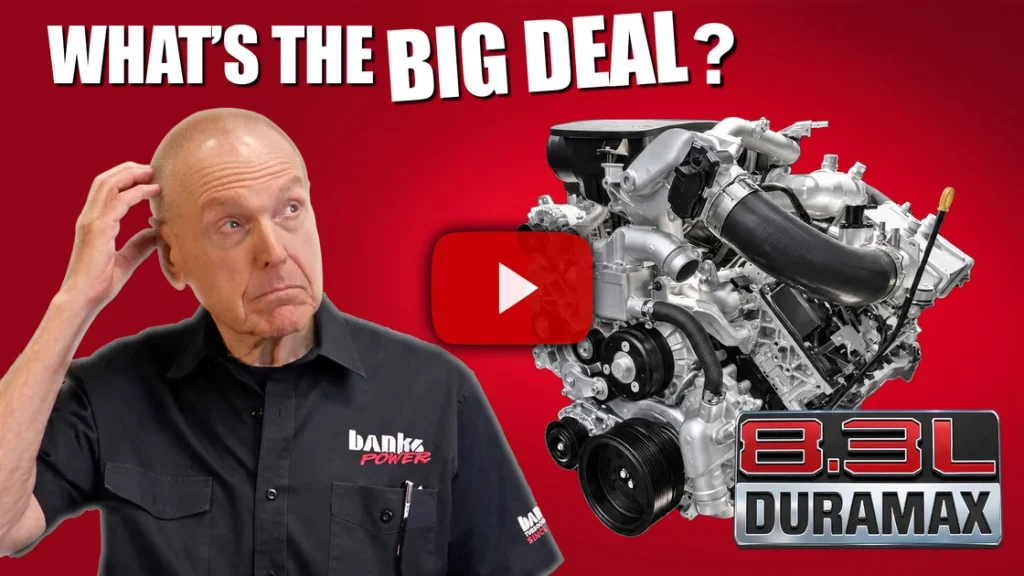
General Motors has reignited the heavy-duty diesel horsepower war with its all-new 8.3-liter Duramax L6P. Codenamed “Mongoose,” the new V8 produces 555 horsepower and 1,230 lb-ft of torque. But according to Gale Banks, the more revealing number isn’t horsepower. It’s horsepower per liter.
Banks uses specific output, horsepower per liter, as an indicator of how hard an engine is being asked to work. The L6P produces 66.9 hp/L, compared with 71.2 hp/L for the outgoing 6.6L L5P. Ford’s 6.7L Power Stroke, at 500 horsepower, produces 74.6 hp/L.

That lower specific output is not accidental. GM engineers told TFL Truck that increasing displacement allowed them to reduce specific output, lowering combustion and exhaust-gas temperatures and helping reduce NOx formation. In other words, GM didn’t simply make the engine bigger to produce more power. They increased its displacement to produce more power with less specific stress.
That strategy gives the L6P an interesting advantage in future development. If GM eventually wants more horsepower, it has additional specific-output headroom before reaching the level of the current Power Stroke.
It also provides an intriguing benchmark for Ford. Applying Ford’s current 74.6 hp/L specific output to an 8.0-liter engine would yield approximately 597 horsepower… essentially 600 hp. If Ford responds to the L6P with a larger Power Stroke, the horsepower war could escalate quickly.
The L6P’s durability story begins with its compacted-graphite-iron (CGI) block. CGI provides substantially greater strength than conventional gray iron while allowing engineers to control mass, making it particularly attractive for a high-cylinder-pressure diesel.
Banks has firsthand experience with the material. More than two decades ago, Banks used a CGI block for a military-related 5.9L Duramax program that produced 735 horsepower, or an astonishing 118.6 hp/L, while being engineered for demanding durability requirements.
GM has now paired CGI with an equally serious bottom end: a fully forged crankshaft, forged-steel connecting rods and steel pistons.
The steel pistons are particularly significant. Unlike aluminum, steel conducts heat less readily, allowing the piston crown and combustion bowl to withstand higher thermal loading. The tradeoff is that the heat must be aggressively removed. GM addresses that with electronically controlled piston-cooling jets and a variable-displacement, gear-driven oil pump that can increase cooling flow when the engine is under heavy load while reducing parasitic losses during lighter operation.
It is a combination Banks describes as essentially a “marriage made in heaven”: CGI structure underneath, steel pistons above it.
The L6P also gets a substantially larger turbocharger. GM has confirmed a high-efficiency variable-geometry turbocharger, but it has not disclosed the inducer or exducer dimensions, so the exact increase in compressor and turbine wheel size remains unknown.
What is clear from the engine’s architecture is that the turbocharger has been engineered for significantly greater airflow than the L5P. The L6P combines the larger turbo with a new two-stage water-to-air charge-air cooling system.
That system is important because the goal isn’t simply to make more boost. The first-stage “knockdown” cooler rapidly removes heat from the compressor discharge, followed by a second water-to-air cooler before the air reaches the intake manifold. The shorter, more compact air path should also help reduce charge-system volume and improve transient response.
For a truck engine expected to pull enormous loads up long grades, thermal control is every bit as important as peak airflow.
The L6P makes its 1,230 lb-ft peak at just 1,400 rpm and maintains more than 1,200 lb-ft through a broad portion of the operating range. Rated horsepower arrives at 2,500 rpm—300 rpm earlier than the L5P’s 2,800-rpm peak.
That low-speed emphasis is consistent with GM’s decision to move toward a larger-displacement, lower-specific-output architecture. The engine doesn’t need to spin harder to make the numbers. It makes them with displacement, airflow and cylinder pressure at relatively low engine speed.
The result is an engine designed around the realities of heavy-duty work: enormous low-rpm torque, sustained thermal control and structural strength.
And that may be the most interesting thing about the L6P. GM didn’t simply build a bigger Duramax. It appears to have deliberately created a platform with **more displacement, lower specific output and substantial thermal and structural headroom**.
For Ford, the math is already on the wall. If the next Power Stroke grows in displacement while retaining its current specific output, 600 horsepower is no longer a theoretical milestone. It becomes a straightforward calculation.
The diesel horsepower war is back. And this time, the battle is being fought as much with materials, airflow and combustion temperature as it is with horsepower.
It’s worth noting that Duramax owners can add a simple modification to beat the L6P’s rated horsepower. Assuming a 10% drivetrain loss, the L6P will put 499.5 hp to the ground. A Banks Derringer tuner-equipped 2020-23 Duramax will make 523 at the rear wheels, and a Derringer-equipped 2024-26 Duramax will put down 519 hp to the ground.
If the L6P’s power and torque is appealing but the price tag of a new truck isn’t, adding a Derringer to your L5P is a cost-effective, engine-safe and warranty-safe solution.

