



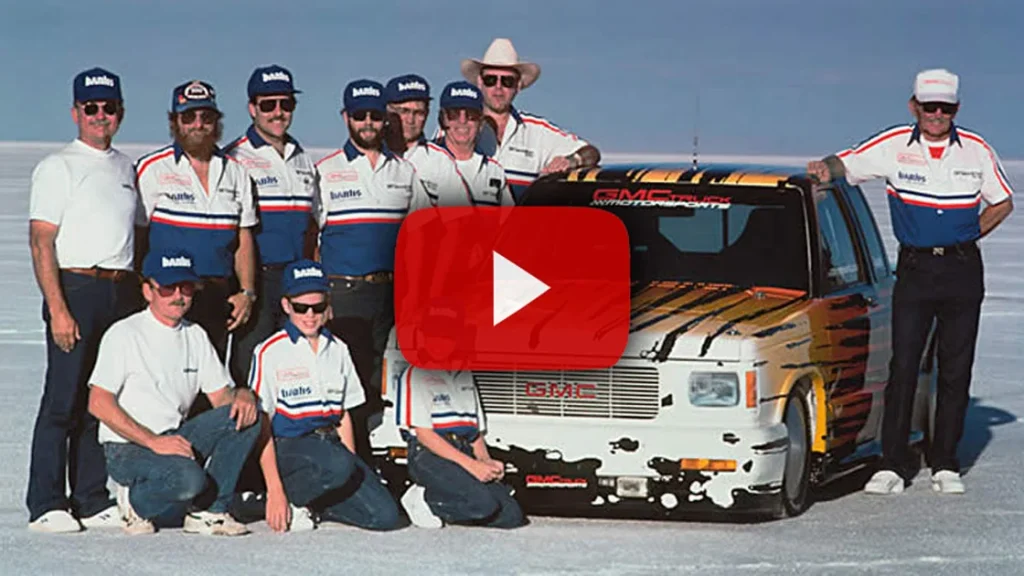
00:00 The Quest For Speed is almost as old as the Auto industry itself and for more than 70 years the place to race flat out has been the Bonville Salt Flats so it wasn’t surprising that when General Motors Corporation set out to conquer a new speed barrier they came to the Salt
00:18 Flats but it might be surprising that the vehicle they brought was a mini pickup last year this GMC S15 pickup set the record as the world’s fastest pickup truck this week the team from GMC and Gail Banks Engineering returned to set new records and for the first time to break
00:39 the 200 mph barrier in a pickup this truck is known as the Cyclone LSR for land speed record it’s powered by a 550 horsepower V6 engine and it rolls on street legal BF Goodrich radial tires the first trip down the salt was a Sizzler better than 205 5 mph the return
01:02 run was also over the coveted 200 mph barrier the two-way average 23.9 mph a new world record the team continued trying to push the record even higher until one dazzling run at more than 210 mph they were able to push the record average over 24 mil an hour presumably where it will stay for the
01:28 foreseeable future
Banks’ history is rich with record-setting cars, trucks, and boats. One standout milestone was the naturally aspirated Banks GMC S-15 Syclone LSR (Land Speed Record). Gale Banks’ original concept was to run a full-size Sierra using all-wheel drive for superior traction on the salt, powered by a twin-turbocharged 502 cubic inch big block. However, General Motors, who asked Gale to set the record using their truck platform, had different plans.

Gale’s hopes of building a twin-turbo monster were squashed during an early planning meeting. Chevrolet executives insisted that if GM was going to back a full-size performance truck, it had to wear a bowtie. GMC representatives pointed out that they did not currently offer all-wheel-drive trucks and none of their production models were turbocharged yet. GM’s leadership wanted the truck to represent a hopped-up version of a production vehicle. That left Banks with the compact S-15 pickup, powered by a naturally aspirated V6.

The largest factory displacement available in an S-15 was a 4.3-liter V6. Gale bored and stroked the production block out to 5.0 liters, but more power was still required to eclipse the 200-MPH mark. A master of turbocharging and airflow density, Banks devised an ingenious way to “supercharge” the intake charge without a blower. High-velocity ambient air was rammed into twin frontal air scoops, routed through heat exchangers chilled by an ice-water tank in the bed, and directed into a custom manifold with velocity stacks. Chilling the intake air by 55°F added +30 horsepower through pure air density gains alone.

At Bonneville in 1989 and 1990, the Banks Syclone LSR—despite having the aerodynamics of a brick—shattered five world records, including an official FIA International World Speed Record of 204.145 MPH and a top exit speed of 210 MPH. Following the truck’s record-shattering triumph, GMC did in fact put the turbocharged, all-wheel-drive production Syclone into showrooms. Just imagine what Gale could have achieved if GM had green-lit his twin-turbo big-block Sierra from day one!