



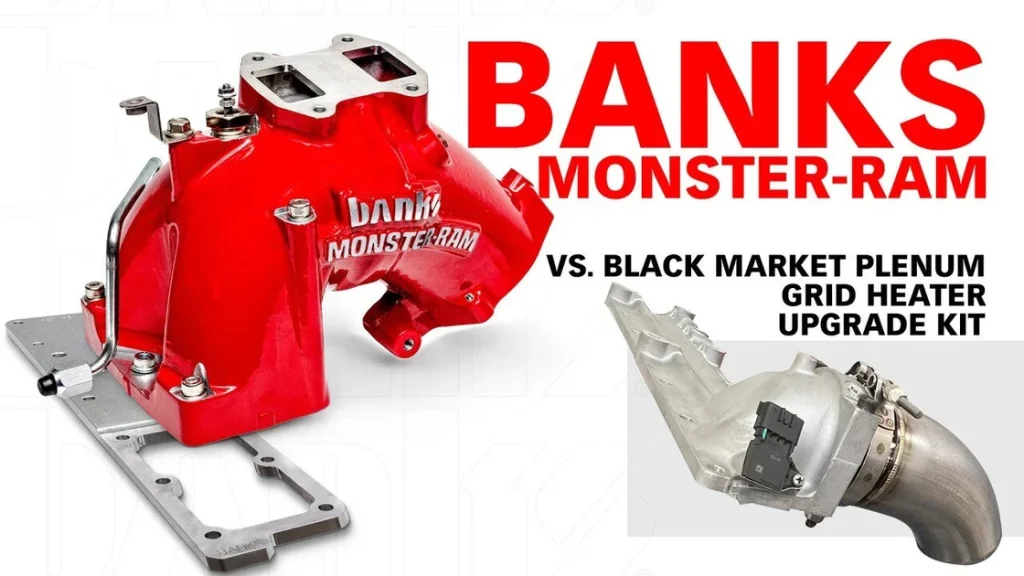
RAM 6.7L owners have choices when it comes to preventing grid heater bolt failure. But one option that should not be on anyone’s list is from Black Market Performance, aka BMP. While the BMP 6.7 Cummins Open Grid Plenum offers the allure of eliminating the failure-prone factory grid heater, it results in a loss of horsepower. Yes, with this installed, your engine will lose horsepower.

Everyone knows the stock intake elbow and grid heater is incredibly restrictive (Gale has proved it on the dyno and flow bench). While this is true, the BMP kit is worse. The intake plenum (Cummins part # 4930917) is found on constant-duty Cummins QSB industrial engines used in applications like stationary generators. In other words, these engines are designed to run at a single RPM. Rated for only 130–275 hp, they require far less air mass than what is required in automotive pickup applications.
We wondered, “Is it as restrictive as it looks?” So, we purchased one and tested it on our calibrated SuperFlow flow bench. Then, for accuracy, we tested the stock intake elbow with the factory grid heater, and the Banks Monster-Ram with high-flow billet intake plate, all in the same session, on the same morning. The average RAM 6.7L engine flows 50 pounds per minute, so that’s where we tested them.

Here’s what we found. Thanks to the harsh 90-degree bend, hard casting edges, and a 1/4″ step where the tube meets the intake plate, the BMP kit flows almost 33% less air mass than stock. In other words, the engine loses boost pressure with the Black Market elbow. Your turbocharger will be forced to work harder to push air past the newly introduced restrictions. The result is mushier throttle response and less power. You can review our full flow bench testing data here.

Taking a closer look at the Banks Monster-Ram, the difference between it and the stock elbow is undeniable. The Monster-Ram’s outlet is more than twice the size of the factory opening. The casting is so massive that we had to engineer a proprietary #1 fuel line to jump over the Monster-Ram. Every contour of the Monster-Ram has been sculpted for superior airflow. Using computational fluid dynamics, our engineers turn the air 180° while increasing air mass density. Gale Banks hails this as one of his best achievements.

The secret to the Monster-Ram’s performance is not just volume, but the density and mass of the air it flows. Your Cummins engine is limited in the volume of air it can displace through its 6 cylinders at a given RPM. However, the engine is not limited when it comes to air mass—there is ample overhead to take advantage of, which Gale explains in depth here. By increasing the mass of air delivered to each cylinder, your stock-tuned engine will breathe more efficiently with lower exhaust gas temperatures and set the stage for massive power gains when stacked with custom tuning.