



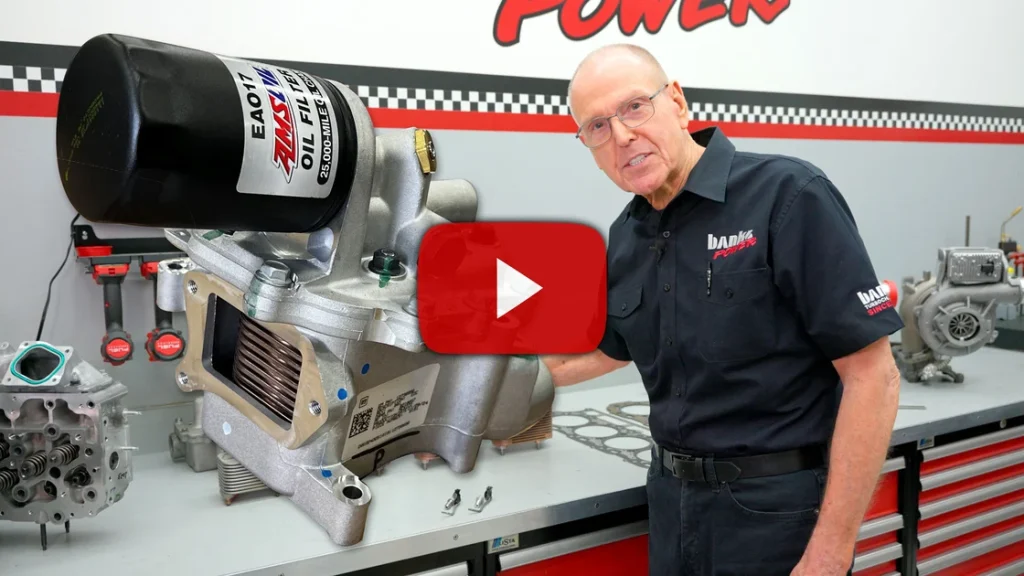
Gale Banks immediately keyed in on the factory Duramax oil cooler. Without hesitation, he dissected each generation. Earlier 2001 to 2010 coolers feature only 11 cooling plates. Models from 2011 to 2016 use 12 plates, and 2017 to 2019 units have 14 plates. In contrast, the latest GM design boasts 19 cooling plates and streamlined coolant passages.
Banks engineered a complete upgrade kit to bring this massive 19-plate cooler to earlier trucks. The system improves thermal heat rejection by 31 percent or more on 2001 to 2019 Duramax engines. In addition, the kit includes a pre-tapped port for oil temperature sensors, complete gaskets, and an AMSOIL filter.

It became clear that we could take advantage of the massive oil cooler by creating a package that would allow 2001-2019 Duramax owners to retrofit their oil coolers with the new 2025 unit. The Banks Oil Cooler Upgrade Kit improves heat reduction 31% or more on 2001-2007 and 2011-2019 6.6L Duramax engines. The older the truck, the greater the gain. The kit includes a new GM 2025 oil cooler with 1/8″ NPT port for temp sensor, all necessary hardware, and an AMSOIL oil filter.


00:00 The whole idea here is, will this thing fit the earlier model trucks 01 through 10? That’d be LB7, LLY, LBZ, and LMM all use the same cooler oil filter assembly. LML, I don’t have one. So, we’re going to go right to 2017 through 19. This is the early L5P. For 2020, they’ve upgraded the maximum
00:30 towing capacity. If you’re going to run at rated power or close to rated power with a heavy load and just hold it there, you’re going to make some temperature. You got to have adequate water pump, fan, radiator, and adequate oil pump, which they already have. Adequate oil cooler
00:51 because the oil is going to take a lot more heat rejection under sustained power. All right. Oh, mercy. So, how do these things compare? The same style of plate is used starting all the way back in 01 on the LB7s. And this early cooler has 11 plates. The oil goes into this stack of
01:22 plates, through the plates, and out. And water flows through the housing from the entrance hole to the exit and through an elbow and up into the torque converter housing and then across the block in the back. It enters on the left side and then it goes through a duct in the torque converter
01:46 housing and enters on the right cylinder bank. 17 18 19 oil cooling plates on the 2020. We have 14 plates on the 17 to 19 and we have 11 on the 01 through 10. So the design change from 19 to 20 is pretty obvious. If you look in here as the water flows, this looks
02:16 promising, but the actual opening into the earlier housing is much smaller. It got better. If you look at this one, there’s your opening, but the entrance into the housing is much larger. Any way you look at this, bottom line is I want minimum pressure drop through the oil
02:36 filter and minimum pressure drop through the cooler and I want maximum cooling of the oil. So, we put a kit together that allows you to do this. All the parts, all the hard to find items are in the box. You can heavyduty oil cool all the way back to 01. You can explore the full lineup of Banks Duramax oil coolers on bankspower.com.
Heavy towing pushes Duramax engine oil to dangerous thermal limits. Hardworking piston cooling squirters dump intense combustion heat straight into the lubrication system. In older trucks, oil temperatures frequently soar past 260 degrees Fahrenheit. Excessive heat shears motor oil viscosity and degrades protective lubricating films. Older 2001 to 2019 factory coolers only utilize 11 to 14 internal cooling plates. This limited surface area chokes heat transfer and leaves engines vulnerable during steep mountain pulls.
The Banks oil cooler upgrade resolves this bottleneck with modern 19-plate heat exchanger technology. Expanding the plate stack increases surface area for rapid heat transfer between oil and coolant. Smoother internal water jackets reduce coolant restriction while maintaining steady oil pressure. Dyno testing proves this system sheds 31 percent more heat on high-output builds. An integrated sensor port connects directly to the Banks iDash for real-time oil temperature monitoring.