



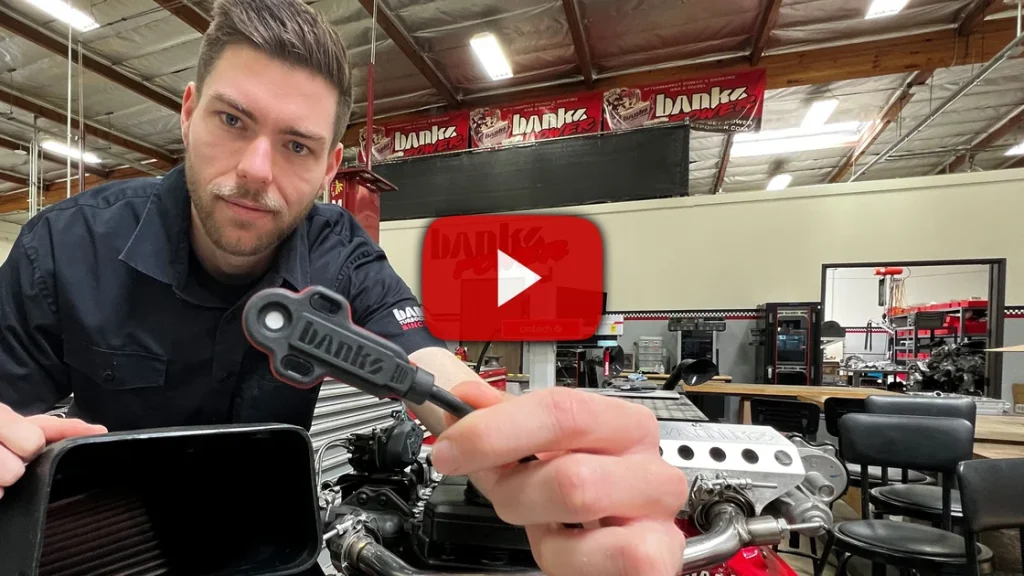
Intake system evaluation is critical for understanding how much airflow your engine receives and where restrictions occur. The Banks AirMouse sensor module, paired with the iDash, makes this process simple and precise. How restrictive is that new air filter? How much power potential is lost in the intake system? Maybe you have a race car and want to fabricate the airbox inlet in a high-pressure zone but don’t know where it is; grill, remove a headlight, hood scoop? Take a lap around the track and the Banks AirMouse will tell you. The compact sensor module turns your Banks iDash digital gauge into a powerful portable weather station that moves with your vehicle, unlocking ambient air conditions and exclusive calculated parameters that you’ll find incredibly handy in evaluating your engine’s airflow.
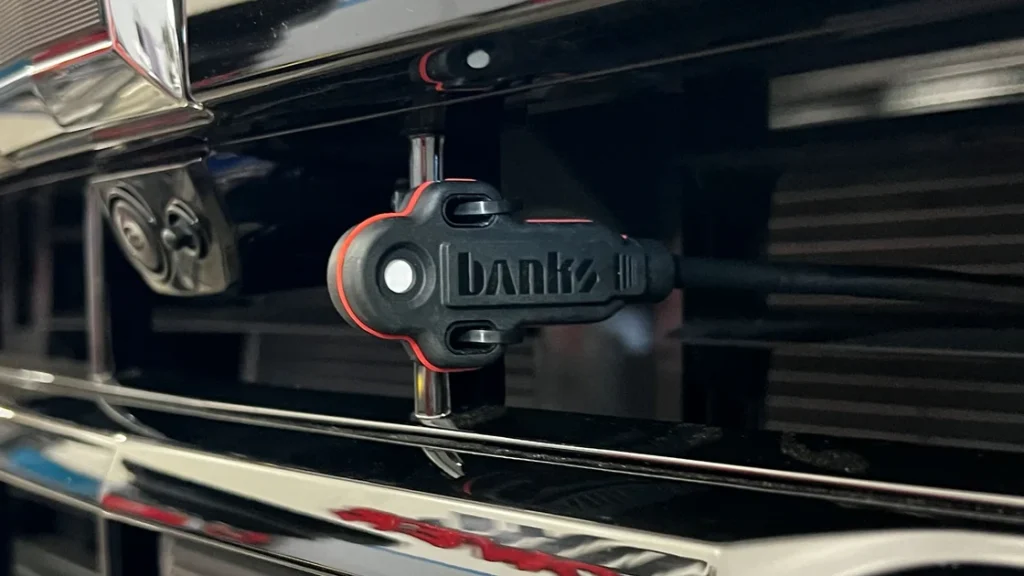
Mount the AirMouse in the grille, intake system, or anywhere you want to measure airflow. An iDash Pro and AirMouse is a game-changer for engine builders, tuners, racers, RVers, or anyone curious about real-time ambient conditions. It’s the most powerful, affordable, airflow performance tool.

When it comes to intake system evaluation, precision data makes all the difference. The Banks AirMouse paired with the iDash Pro gives you the insights you need to identify airflow restrictions, measure ambient pressure zones, and optimize your intake setup for maximum power.
Whether you’re a racer looking for the best spot to pull cold air, an engine builder fine-tuning performance, or an RVer curious about real-time ambient conditions, the intake system evaluation tools from Banks Power deliver the answers. The AirMouse sensor easily mounts in the grille, airbox, or anywhere airflow data is critical, providing accurate, real-time feedback right on your iDash display.
What sets the Banks AirMouse apart is its affordability and power — it’s a portable, on-the-go weather and airflow station that moves with your vehicle. Combined with the iDash Pro, you get a level of intake system evaluation that was once only available to professional tuners. For anyone serious about maximizing airflow and unlocking engine performance, the Banks AirMouse is the ultimate tool.
00:00 Engines don’t make power from fuel alone. They make power from the oxygen in the air. So, if you don’t know the conditions of the air your engine is breathing, you’re tuning blind. Let me show you how you can not only view this data in real time, but record it. This
00:14 is the Bank’s eye dash. It’s every gauge you’ve ever used, plus many you’ve never seen before. It displays pressures, temps, speeds, RPMs, wideband 2, and data from just about any sensor. It also displays calculated parameters that no other instrument can. This is the Bank’s
00:29 Air Mouse ambient air sensor. By adding a Bank’s air mouse, the Adash becomes a powerful portable weather station. You unlock all the ambient air conditions as well as a host of other calculated parameters that you’ll find quite handy. First, you’ve got ambient air
00:43 temperature, the thermal energy of the air molecules viewed here in Fahrenheit. We also have Celsius and Kelvin or Rankin. Then there’s ambient air pressure, the force exerted by the air itself shown here in PSI. We also have kilopascals, bar, or inches of mercury.
00:56 The air mouse also displays humidity and in two flavors. Relative humidity is the percentage of how saturated the air is. And grains of H2O shows the actual water vapor in the air with 7,000 g equaling a pound of water. But the most important value, ambient air density mass. It’s
01:13 the actual weight of the air in pounds per thousand cubic feet or kg per 100 cubic meters calculated from pressure, temperature, and humidity. It’s how we measure the amount of oxygen molecules your engine is pulling in. Denser air means more oxygen, which means more power. With that info, the Idash
01:30 calculates power potential and shows you air density ratios. That’s where dry day standards like SapJ 607 and J1349 come in. Correction factors for dyno testing. So, if you’re running in conditions that only give you, say, 99.4% of J1349, you know your engine’s power is down6% even
01:48 before you hit the throttle. The dash also shows you density, altitude, and pressure altitude. Density altitude tells you how high up your engine thinks it is based on the actual air density. The thinner the air, the higher the number, even if you’re physically at sea
02:02 level. It’s often used by pilots. It’s a great way to understand how elevation and weather are affecting your power. Pressure altitude is based on a standard barometric pressure of 14.7 psia at sea level, but here it helps you track how far off your current pressure is from
02:17 the standard. Typically about a half pound of air for every,000 ft of altitude. The Bank’s air mouse allows you to measure the losses from the grill to the turbo or in the case of a naturally aspirated vehicle from the grill to the intake manifold. Here we’re using the Bank’s air mouse to take
02:31 measurements down to -40° F in a controlled climate chamber or take it out to the desert with its 150° upper threshold. When you’re testing a part in a dino cell environment, you want that part to be the only variable. We use an air mouse every time we test to ensure
02:47 that if the air density changes, we know about it. Level up your Bank’s eye dash by turning it into a powerful portable weather station with the Banks Air mouse.
Airflow into an internal combustion engine is governed by fluid dynamics and aerodynamic pressure fields across the vehicle body. As a vehicle travels down a track or highway, air does not flow uniformly around the front fascia; instead, it generates distinct zones of high stagnation pressure as well as regions of low-pressure separation. Inlets positioned in aerodynamic separation zones or turbulent engine-bay eddies inhale low-density air, starving the engine before the filter element even encounters resistance. By utilizing the Banks AirMouse to perform empirical road and track testing, tuners can accurately map local static and dynamic pressure zones across the grille, hood scoops, and headlight ducts. Applying Bernoulli’s equation ($P_{total} = P_{static} + \frac{1}{2}\rho v^2$), builders can locate genuine high-pressure stagnation points where velocity head is converted into positive static pressure, offsetting induction duct drag and packing denser air into the intake tract.
Combustion horsepower is fundamentally an oxidation reaction determined by the mass flow of oxygen molecules, not volumetric air flow or boost pressure alone. The ambient air’s psychrometric state—the thermodynamic balance between dry-bulb temperature, barometric pressure, and water vapor grains—dictates true oxygen density. High humidity severely degrades performance because water vapor displaces dry oxygen molecules in a given volume of air. Using laboratory-grade environmental sensors protected by a breathable Gore-Tex® membrane, the Banks AirMouse continuously logs barometric pressure, temperature, and humidity grains, enabling the iDash to calculate ambient air density mass in pounds per thousand cubic feet. This calculation provides instant SAE J607 and SAE J1349 dyno correction factors, allowing engine builders to immediately discern whether a measured change in power is due to hardware alterations or subtle shifts in atmospheric oxygen content.
A thorough intake system evaluation also requires analyzing cumulative restriction and pumping losses throughout the induction path. By referencing ambient atmospheric conditions captured by the AirMouse at the vehicle nose, tuners can deploy supplementary Banks pressure sensors along the airbox, clean-air ducting, and turbocharger compressor inlet to measure total pressure drop ($\Delta P$). Excessive depression across an air filter or restrictive intake elbow forces the compressor into inefficient, higher pressure ratios, escalating compressor discharge temperatures and compounding thermal load on the intercooler. By combining the AirMouse with the iDash Pro’s high-frequency datalogging, enthusiasts and calibration engineers replace guesswork with hard empirical data—ensuring every intake component is optimized for minimum pumping work and maximum cylinder air mass.
Related Airflow Engineering & iDash Tech Articles